


Thank you to Andrei Romanov for part 2 of his fascinating series. Part 1 can be found here.
Part 2 of 3: The Padrões as Strategic Instruments
In Part 1, we examined what the padrões were: limestone pillars erected by Portuguese navigators along the African coast in the 1480s as territorial markers. We described their physical construction, the ceremony of their erection, and the voyages of Diogo Cão, who planted them at the furthest reaches of the known world.
But the padrões were not merely monuments. They were strategic instruments in a distinctly Portuguese approach to empire, one that prioritised marking over occupying, inscription over settlement, and symbolic sovereignty over territorial control.
This approach would shape not only Portuguese expansion but the entire European colonial project. To understand how, we need to examine what the padrões meant in legal and strategic terms, and how the Portuguese model of maritime empire differed from the territorial strategies that Spain, the Dutch Republic, and later Britain would adopt.
The legal fiction of discovery
When Diogo Cão planted a padrão on the southern bank of the Congo River in 1482, he was enacting a legal claim rooted in a framework of European international law that had been developing since the thirteenth century. 1
The doctrine of discovery, rooted in a series of papal bulls issued in the 1450s that granted Portugal specific rights over lands discovered along the African coast, and later formalised in the jurisprudence of later centuries, held that Christian European powers could claim sovereignty over territories inhabited by non-Christian peoples simply by being the first Europeans to arrive there and perform certain ritualised acts of possession. 2 The padrão was one such act.
The legal logic was circular and self-serving. The padrão declared Portuguese sovereignty. Portuguese sovereignty rested on the act of planting the padrão. The consent of the people who actually lived on the land was irrelevant, because they were not Christian, and therefore, according to European legal theory, they did not possess full sovereignty over their own territories. 3
This was not merely theoretical. The padrões served as evidence in diplomatic disputes. When Spain and Portugal contested control over newly discovered territories, the padrões functioned as proof of prior Portuguese presence. The Treaty of Tordesillas in 1494, which divided the non-European world between Spain and Portugal along a meridian 370 leagues west of the Cape Verde Islands, was predicated on precisely this kind of claim: that discovery, marked by physical monuments and recorded in chronicles, constituted a legal basis for sovereignty. 4
The padrão, in this sense, was not just a marker. It was a legal instrument. It made Portuguese sovereignty legible to other European powers, even if it remained meaningless to the African and Asian peoples whose lands it purported to claim.
Marking, not occupying
The Portuguese approach to empire was shaped by demographic and economic constraints that other European powers did not face, at least not to the same degree.
Portugal in the late fifteenth century had a population of approximately one million people. 5 It did not have the human resources to settle vast territories in Africa or Asia in the way that Spain would later settle the Americas. Even if it had, the economic logic of Portuguese expansion did not require settlement. What Portugal wanted was not land, but access: access to the sources of gold, ivory, and slaves in West Africa, and later, access to the spice-producing regions of the Indian Ocean.
The padrão reflected this strategic priority. It marked a claim without requiring occupation. It asserted sovereignty without requiring settlers. It was a placeholder, a legal fiction that reserved Portuguese rights over a coastline or a trade route without committing resources to defend or administer the territory in question.
This approach allowed Portugal to construct what historian A.J.R. Russell-Wood has called a ‘scattered empire’ or an ’empire of the sea’: a network of coastal fortresses, trading posts, and strategic islands connected by maritime routes, rather than a contiguous territorial empire. 6
The padrões were the visible markers of this scattered empire. They dotted the African coast at intervals, like breadcrumbs leading from Lisbon to the Cape of Good Hope, and eventually, across the Indian Ocean to Goa, Malacca, and Macau. They did not mark the boundaries of Portuguese territory. They marked the extent of Portuguese ambition.
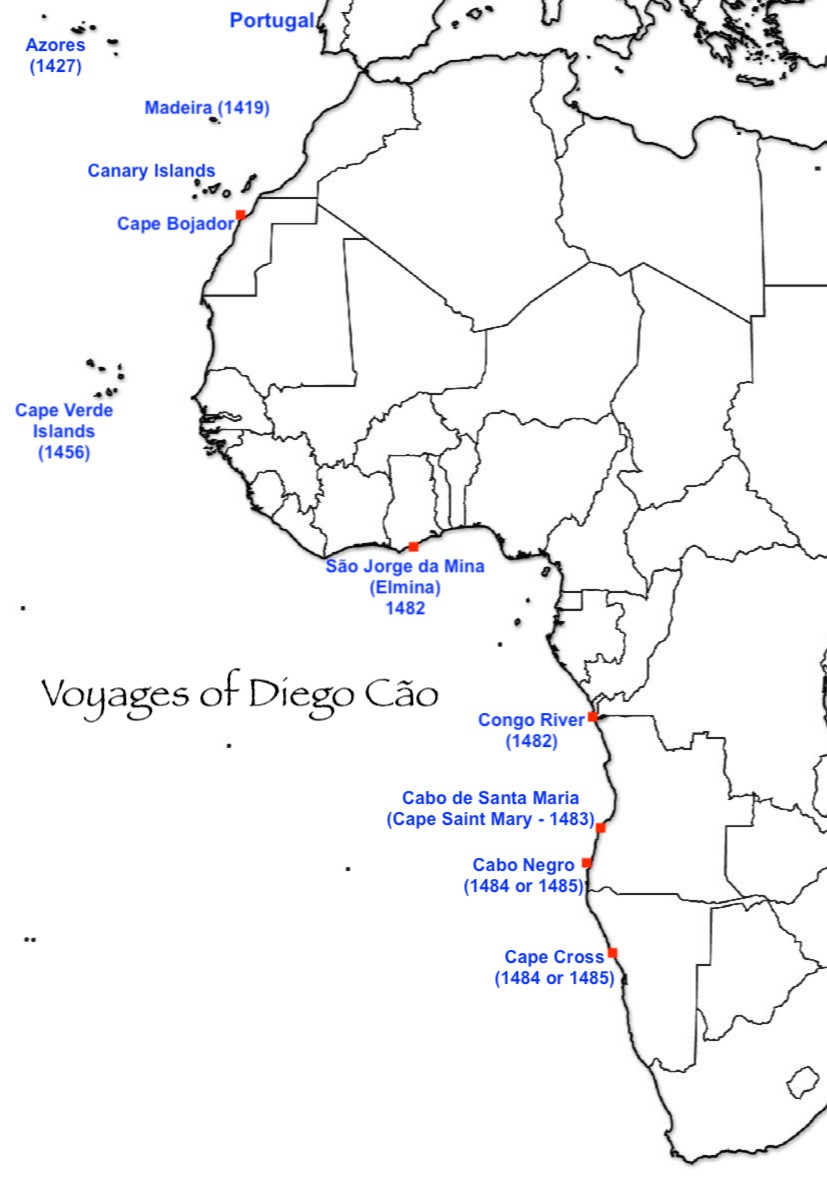
Map showing Diogo Cão’s two voyages along the West African coast (1482–1486) and the locations where he erected padrões. Each marker represents a territorial claim that extended Portuguese sovereignty thousands of miles from Lisbon. Source: Adapted from historical cartography / Explorers Podcast
The Portuguese model versus the Spanish model
The contrast with Spanish colonial strategy is instructive.
When Christopher Columbus returned from his first voyage to the Americas in 1493, he brought back gold, exotic plants, and several Taíno people whom he had taken from the islands and brought before the Spanish court as living evidence of his discoveries. Spain’s response was not to plant pillars. It was to send settlers. 7
Columbus’s second voyage in 1493 included seventeen ships carrying over 1,200 men, along with seeds, livestock, tools, and supplies for establishing permanent settlements. Spain’s imperial model in the Americas was, from the outset, one of territorial conquest and colonisation. It sought to transplant Spanish society, Spanish religion, Spanish law, and Spanish agriculture onto the lands it claimed.
Portugal could not do this, and did not need to. The Portuguese were not discovering uninhabited islands or sparsely populated continents. They were navigating along coastlines that were already densely inhabited, already integrated into complex trade networks that stretched across the Sahara, the Indian Ocean, and the South China Sea. Portuguese strategy was not to conquer these regions but to insert itself into the existing networks and extract profit through trade, tribute, and, increasingly, violence.
The padrão was the perfect symbol of this strategy. It claimed everything and controlled nothing. It asserted Portuguese presence without requiring Portuguese administration. It was sovereignty as performance, empire as theatre.
The Dutch and British models: occupation and administration
The Portuguese scattered empire model would be challenged, and ultimately supplanted, by the more territorially aggressive strategies of the Dutch and the British in the seventeenth and eighteenth centuries.
The Dutch East India Company, founded in 1602, did not plant pillars. It built forts, established garrisons, and negotiated treaties that gave the VOC exclusive trading rights backed by military force. The Dutch model was not merely symbolic. It was systematically coercive. Where the Portuguese padrão marked a claim, the Dutch fort enforced it. 8
The British East India Company, similarly, did not rely on symbolic acts of possession. It negotiated commercial treaties, established presidencies at Bombay, Madras, and Calcutta, and gradually transformed itself from a trading company into a territorial power administering vast regions of the Indian subcontinent. 9
By the mid-eighteenth century, the Portuguese model of scattered coastal enclaves marked by padrões and defended by undermanned fortresses was obsolete. The future of empire belonged to powers that could project sustained military force, administer large territories, and extract resources through systematic colonial governance.
The padrões, in this context, look almost quaint. They were the relics of an earlier, more tentative phase of European expansion, when a limestone pillar and a Latin inscription could plausibly constitute a claim to half the world.
The symbolic afterlife of the padrões
And yet the padrões endured, long after the strategic logic that produced them had faded.
The Cape Cross padrão stood on its Namibian headland for over four hundred years, weathered by salt and wind, until the crew of a German warship removed it in 1893. The padrão from the mouth of the Congo River was taken to Lisbon and installed in the courtyard of the Geographical Society, where it remains today. Others were lost, destroyed by erosion, iconoclasm, or simple neglect. 10

The padrão at Cabo Negro (Monte Negro, Angola), photographed in the early twentieth century. Erected by Diogo Cão during his second voyage (1485–1486), this pillar stood on the African coast for over four hundred years before being removed to Portugal.
The removal of these pillars to European museums raises questions that go beyond the history of maritime exploration. What does it mean that the oldest surviving European monuments in sub-Saharan Africa are no longer in Africa? What does it mean that objects erected as symbols of Portuguese sovereignty now sit in museums in Berlin, Lisbon, and Cape Town, displayed as artefacts of a vanished imperial order?
These are not merely historical questions. They are questions about memory, heritage, and the politics of the past in the present. The padrões, in their scattered afterlives, continue to mark something: not Portuguese sovereignty, but the enduring legacies of European colonialism and the contested ownership of its material traces.
In Part 3, we will turn to these questions. Where are the padrões today? Who owns them? And what do they mean now, five centuries after Diogo Cão first planted one on the banks of the Congo River?
- On the development of European legal doctrines of territorial acquisition, see Anthony Pagden, Lords of All the World: Ideologies of Empire in Spain, Britain and France c.1500–c.1800 (New Haven: Yale University Press, 1995), chapters 1–2.
- The key papal bulls are Dum Diversas (1452), Romanus Pontifex (1455), and Inter Caetera (1456), each issued by Nicholas V or Calixtus III and granting Portugal rights of conquest and trade along the African coast. For their text and context, see Frances Gardiner Davenport, ed., European Treaties Bearing on the History of the United States and Its Dependencies to 1648 (Washington: Carnegie Institution, 1917), 9–32.
- For a critical analysis of the doctrine of discovery and its application in Portuguese expansion, see Lauren Benton, A Search for Sovereignty: Law and Geography in European Empires, 1400–1900 (Cambridge: Cambridge University Press, 2010), 29–56.
- On the Treaty of Tordesillas and the role of prior discovery in its negotiation, see C.R. Boxer, The Portuguese Seaborne Empire, 1415–1825 (London: Hutchinson, 1969), 36–42.
- On Portugal’s population and the demographic constraints on its imperial expansion, see Malyn Newitt, A History of Portuguese Overseas Expansion, 1400–1668 (London: Routledge, 2005), 12–18.
- A.J.R. Russell-Wood, The Portuguese Empire, 1415–1808: A World on the Move (Baltimore: Johns Hopkins University Press, 1998), 6–12.
- On the contrasting colonial strategies of Portugal and Spain in the late fifteenth and early sixteenth centuries, see J.H. Elliott, Empires of the Atlantic World: Britain and Spain in America, 1492–1830 (New Haven: Yale University Press, 2006), 3–28.
- On the VOC’s territorial strategies in the Indian Ocean, see Femme S. Gaastra, The Dutch East India Company: Expansion and Decline (Zutphen: Walburg Pers, 2003), 31–56.
- On the transformation of the British East India Company from a commercial to a territorial power, see Philip J. Stern, The Company-State: Corporate Sovereignty and the Early Modern Foundations of the British Empire in India (Oxford: Oxford University Press, 2011).
- On the fates of individual padrões and their removal to European museums, see Russell-Wood, Portuguese Empire, 58–60.


