


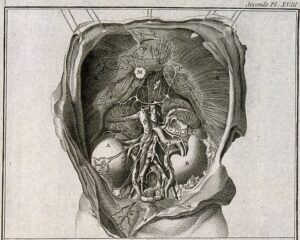
Anatomy of the abdomen (detail), showing the kidneys, the intestines, etc., after Albrecht von Haller (1708–1777). Engraving by Jacques Renaud Benard (1731–1794), late 18th century. (Wellcome Collection 35094i. Public domain.)
Continuing our series of blog posts on the theme of “Health at Sea in the Age of Sail,” this month we consider one specific illness that was associated with an imbalance of the bodily “humors”: nephritis, an inflammation of the kidneys that was perhaps surprisingly common at the time.
A sailor might first notice a deep pain in the loins, dull at first and then sharp and unrelenting. Fever followed. The urine, once freely passed, became scanty, ‘high-colored,’ or tinged with blood.1,2 Surgeons recognized this pattern as nephritis—an inflammation of the kidneys that could prove as dangerous as any epidemic. Some illnesses at sea arrived with spectacle—the spotted rash of typhus, the black vomit of yellow fever, the swollen gums of scurvy. Others, among them nephritis, declared themselves more quietly but with equal menace.
To an eighteenth-century naval surgeon, suppression of urine was a grave sign.3,4,5 The body was meant to evacuate its excesses—sweat, stool, blood, and water. Illness was frequently attributed to an imbalance or ‘corruption’ of these bodily humors, which medicine aimed to expel.6 When one of these channels closed, especially the urinary passage, internal heat and corruption were thought to accumulate dangerously.7 Restlessness, delirium, or bilious vomiting (caused by nausea) darkened the prognosis. Surgeons feared that the inflamed kidneys might fall into ‘mortification,’ a fatal decay of the internal parts.8
Life at sea fostered such disorders. Sailors lived on salted beef and pork, dried peas, biscuit, and rum. Fresh water was rationed and often stale. Men labored for hours in heat and humidity, sweating profusely while drinking little beyond their allowance. Wet clothing clung to the body during night watches, and hammocks were rarely dry. These conditions were believed to thicken the blood, irritate the humors, and predispose men to inflammation.9,10 Whether attributed to damp cold, intemperance, or retained fluids, nephritic complaints were a familiar entry in ships’ surgeons’ journals.11
Unlike plague or smallpox, nephritis rarely swept through a crew. It struck individuals—suddenly, painfully, and sometimes fatally—reminding all aboard that the sea shaped not only the voyage but the organs within the sailor’s body.
What was “Nephritis”?
The term nephritis, derived from classical Greek, had long denoted inflammation of the kidneys. In the Age of Sail, it did not describe a single, clearly defined disease but a cluster of related complaints: inflammation of the renal parts, nephritic colic (‘kidney stones’), suppression of urine, and disorders associated with ‘stone’ or ‘gravel.’ Surgeons recognized patterns of pain, fever, and urinary change, interpreting them within a humoral framework rather than a pathological one.
Medical writers distinguished nephritis from simple blockage of the bladder associated with severe pain, known as ‘strangury,’ and from mechanical retention of urine in the bladder. True nephritic disease centered on pain in the loins with fever and changes in the urine—thick, sedimented, bloody, or entirely suppressed. Complete suppression signaled immediate danger.
Inflammation lay at the heart of the explanation. Blood thickened by heat, salted provisions, or strong drink was thought to irritate the kidneys.12,13 Cold exposure might drive humors inward, producing congestion. Retained urine could become acrid. Whatever the trigger, the result was obstructed flow and mounting internal heat. Prolonged obstruction risked suppuration (pus formation) or gangrenous decay.
Modern distinctions—between infection, stone, or failure of the kidneys from severe dehydration—were unavailable to contemporaries. What surgeons confronted was an inflammatory disorder of the loins, manifested by suppressed urine and shaped profoundly by environment.
Salt, Spirits, and Climate
Although nephritic disease was not unique to maritime life, the sea provided ideal conditions for its development. Diet was central. Salted meat, dried peas, oatmeal, and biscuit sustained long voyages, but surgeons observed that heavily salted provisions increased thirst and concentrated the urine. Fresh water was rationed and often foul in tropical climates. Sailors labored in heat and humidity, sweating heavily while drinking little. Although not described in modern terms, dehydration was implicit in complaints of thickened blood and scanty urine.
Alcohol compounded the problem. The daily rum ration, diluted but regular, was widely believed to ‘heat the blood’ and inflame the viscera.14,15 Surgeons frequently linked nephritic attacks to excess spirits.16 Even moderate consumption, combined with salted food and limited fresh produce, was thought to disturb humoral balance.17,18
Climate added further strain. Exposure to cold and damp was constant: soaked watches, wet hammocks, freezing spray. Sudden transitions between tropical heat and cooler decks were believed to drive perspiration inward, congesting internal organs.19,20 Conversely, prolonged heat was said to thin and irritate the blood.21 The kidneys, associated with fluid regulation, were considered particularly vulnerable.
Naval discipline also played a role. Sailors could not always relieve themselves at will; during battle or heavy weather, urination might be delayed. Prolonged retention was commonly cited as a cause of nephritic distress. Thus diet, labor, climate, and command structure combined to make kidney inflammation not accidental but predictable.
“Pain in the Loins”: Presentation and Prognosis
Nephritic illness often began abruptly. A sailor might report severe pain deep in the loins, sometimes radiating toward the groin. Fever accompanied the onset; the pulse grew quick and tense. Urinary alteration was decisive. Surgeons observed its quantity and color carefully. It might be dark and scanty, depositing reddish sediment, or streaked with blood. Thomas Trotter (1760–1832), physician to the British Channel Fleet, noted that sailors suffering nephritic complaints often passed urine that was “… thick and high-coloured, depositing a reddish sediment.”22 In severe cases, only a few painful drops passed—or none at all. ‘Suppression of water’ carried immediate weight.
As the condition progressed, nausea, vomiting, and restlessness followed. Sleep was impossible. Delirium signaled danger. Although some distinguished transient colic from true inflammatory nephritis, such distinctions were uncertain aboard ship. Without instruments beyond the senses and the chamber pot, diagnosis rested on observation and experience.
Suppression meant stagnation. If urine failed to flow, internal heat and corruption were imagined to accumulate. In a medical culture that equated health with proper evacuation, obstruction signified peril.
Bleeding, Blistering, and Limits
Treatment followed antiphlogistic (anti-inflammatory) principles.23 Inflammation required reduction. Bloodletting was the first remedy; young and robust patients might be bled copiously to relieve vascular tension.24 If the pulse remained strong, bleeding might be repeated.25
Warm fomentations were applied to the loins. Cupping and blistering sought to draw inflammation outward through counter-irritation. Barley water, linseed tea, and other diluting drinks were prescribed when supplies permitted. Mild purgatives aimed to reduce internal congestion. Opium offered relief from pain. Diuretics were sometimes attempted in suspected stone.26
Yet maritime practice imposed strict limits. Large obstructing calculi (kidney stones) lay beyond surgical reach. Bladder stone removal was specialized and rarely feasible at sea. Catheterization could relieve bladder retention, but not inflammation higher in the kidneys. If urine failed to return, the surgeon could do little but observe and hope. Some men recovered after days of pain. Others relapsed. A few deteriorated rapidly and died, the log recording simply: “Died of inflammation in the kidneys.” Behind that entry lay suffering and therapeutic constraint.
Regulation and the Maritime Body
Nephritic disease lacked the drama of epidemic fever, yet it reveals something essential about health at sea. It arose not from contagion, but from structure—from diet, climate, labor, alcohol, rationing, and discipline. These were not episodic hazards; they defined maritime existence.
The eighteenth-century ship was a regulated environment. Provisions were preserved, water measured, work relentless. Within this system, the body was expected to endure. When a sailor collapsed with suppressed urine, it marked a failure of regulation—an internal blockage mirroring the constraints of shipboard life.
Early modern medicine placed great importance on evacuation. Health depended upon the regular passage of fluids; obstruction signaled problems. Suppression of urine therefore represented more than a local inflammation. It was a crisis of flow, a breakdown in equilibrium.
Bloodletting and blistering sought to restore movement, to reopen channels and relieve congestion. Sometimes they worked. Often, they did not. Without modern knowledge of infection or renal physiology, surgeons worked within a system that made sense to them, although it could not master every case.
Nephritis thus underscores a broader truth: the sea shaped pathology. Salted food, rationed water, alcohol, exposure, and confinement entered the body and affected its functions. If epidemic diseases dramatized global vulnerability, nephritic inflammation revealed a quieter strain—the burden placed on organs tasked with maintaining balance under extraordinary conditions.
In the Age of Sail, the ocean was both highway and hazard. It carried ships across the world, and it impressed itself upon the bodies of those who sailed them—sometimes in fever, sometimes in scurvy, and sometimes in the searing pain of the loins when the water would not pass.
References
- Northcote, W., 1770. The Marine Practice of Physic and Surgery, including that in the hot countries, particularly useful to all who visit the East and West Indies, or the coast of Africa: to which is added, Pharmacopoeia marina, and some brief directions to be observed by the sea-surgeon in an engagement … London: Printed by W. and J. Richardson for T. Becket and P.A. de Hondt. Pp. 101–103.
- Blane, G., 1784. Observations on the Diseases of Seamen, 2nd ed. London: Joseph Cooper.
- Pringle, J., 1810. Observations on the Diseases of the Army. Philadelphia: Edward Earle.
- Blane, 1784. Op. cit.
- Goddard, J.C., 2005. Genitourinary medicine and surgery in Nelson’s navy. Postgraduate Medical Journal, 81, 413–418.
- Newton, H., 2018. Misery to Mirth. Recovery from Illness in Early Modern England. Oxford: Oxford University Press. Chap. 1.
- Goddard, J.C., 2004. The Navy Surgeon’s Chest: Surgical Instruments of the Royal Navy during the Napoleonic War. Journal of the Royal Society of Medicine, 97, 191–197.
- Goddard, 2005. Op. cit.
- Lind, J., 1757. An Essay on the Most Effectual Means of Preserving the Health of Seamen in the Royal Navy. London: A. Millar.
- Northcote, 1770. Op. cit.
- Goddard, 2005. Op. cit.
- Ibid.
- Northcote, 1770. Op. cit.
- Macdonald, J., 2004. Feeding Nelson’s Navy: The True Story of Food at Sea in the Georgian Era. London: Chatham Publishing.
- Trotter, T., 1804. An Essay, Medical, Philosophical, and Chemical, on Drunkenness, and Its Effects on the Human Body. London: Longman and Rees.
- Goddard, 2005. Op. cit.
- Lind, 1757. Op. cit.
- Vale, B., and Edwards, G., 2011. Physician to the Fleet: The Life and Times of Thomas Trotter, 1760–1832. Martlesham, UK: Boydell Press.
- Lind, J., 1768. An Essay on Diseases Incidental to Europeans in Hot Climates. London: T. Becket and P.A. de Hondt.
- Harrison, M., 2010. Medicine in an Age of Commerce and Empire: Britain and Its Tropical Colonies, 1660–1830. Oxford: Oxford University Press.
- Moseley, B., 1787. A Treatise on Tropical Diseases; and on the Climate of the West-Indies. London: T. Cadell.
- Trotter, T., 1797. Medicina Nautica: An Essay on the Diseases of Seamen, 1. London: T. Cadell Jun. and W. Davies. Pp. 208–210.
- Goddard, 2005. Op. cit.
- Northcote, 1770. Op. cit.
- Lind, 1757. Op. cit.
- Lind, 1757. Op. cit.; Northcote, 1770. Op. cit.; Macdonald, 2004. Op. cit.; Goddard, 2005. Op. cit.


