



New Zealand International Exhibition, Hagley Park, Christchurch
[1906]. CCL-KPCD03-0078. Via Christchurch City Libraries.
Brainchild of Premier Richard Seddon, the New Zealand International Exhibition of Arts and Industries opened in Hagley Park on 1 November 1906. It was part of a trend of expos, Worlds Fairs and exhibitions that continues to this day, and which began with the 1851 Great Exhibition in London. New Zealand and Canada exhibited at many of the subsequent exhibitions, and held their own. Canada built their own Crystal Palace for the Montreal Industrial Exhibition of 1860, and New Zealand held its first exhibition in Dunedin in 1865.
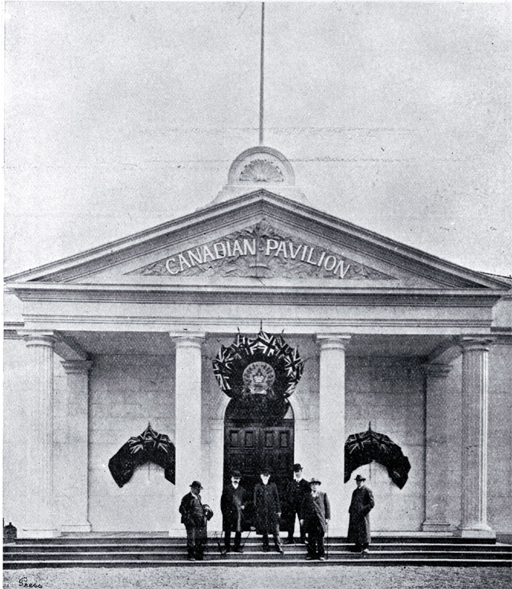
New Zealand International Exhibition : the front of the Canadian Pavilion. [1906] CCL-KPCD06-0083. Via Christchurch City Libraries.
Incomparably the finest commercial and industrial display from outside the boundaries of New Zealand was that furnished by the Dominion of Canada [… ] New Zealanders were not unfamiliar with the enormous range of natural resources and wealth that the great Dominion possesses, but the extraordinarily varied character of her products and the excellence of quality of the articles manufactured from the raw material was an eye opener equally to the businessman and the manufacturer and to the ordinary sight-seeing visitor.
Cowan also reveals that the Canadian authorities are committed to promoting themselves via such exhibitions:
The Domain spends about £50,000 annually this way, and considers the money expended a good investment.
One local paper, the Lyttelton Times, provided an extensive report on the opening events of the exhibition and previews of all the courts. This article records the speeches of the great and the good at opening. The then Premier, Sir Joseph Ward, who was also president of the exhibition, revealed in his address that this event was the most advanced on the opening day of any exhibition:
I thank particularly Canada and Australia for that they have done. The Canadians set a good example. They were the first in the field, and to their credit be it said that the flag was hoisted over the Canadian Court, finally finished, at six o’clock this morning. It was the first flag to fly in token that the Exhibition was completed. (Loud applause).
Hurrah! There were also many messages from the great and the good, including Canada’s Prime Minister Sir Wilfrid Laurier:
“Canada sends greetings to the sister colony on the opening of the Exhibition tomorrow, and best wishes for success. Much gratified to participate, and trust that Canada’s exhibits will add interest.”
Ward’s reply was suitably gushing:
New Zealand heartily reciprocated and appreciates Canada’s good wishes. Exhibition magnificent success. Canada’s display a credit to your country and hope the forerunner of increased commercial relations.

The North-East End of the Canadian Court. Weekly press, 12 Dec. 1906, p.47. Via Christchurch City Libraries
And that was really the crux of the whole endeavour – commerce. So what products did Canada show off at its court? What did it look like? Describing a route around the main building the Lyttelton Times reveals that having reached the end of the southern part of the main building the visitor,
Is close to the Canadian Court, which cannot be missed. The word “Canada” fills the eye, and Canadian products, manufacturers and arts and crafts engage the attention. Canada, of course, has a complete exhibition of her own, and any time can be spent in that court. As a matter of fact, it can be visited again and again, and will always be found to offer fresh attractions.
Well this all sounds lovely! Apparently the mineral section was the most notable of the court. However, its contents haven’t aged well….
Canada supplies 90% of the world’s asbestos. Canadian asbestos has the longest fibre, and for that reason is the most popular for working up into manufactured articles. The exhibit shows asbestos as it is found in the rock, and there are also examples of finished products.
I hope they cleaned up well when the exhibition was over! As well as less toxic minerals, there were examples of wood and wood crafts, papermaking, fibreware, indigenous cedar canoes, maple sugar and honey, galoshes, pianos and a “beautifully arranged” display of bottled fruits. The official record also notes: whisky, bicycles, musical instruments, toys, typewriters and “ladders of all kinds of the latest and most useful patterns”. Phew! There were 1400 cases containing these exhibits, stretching over 14,000 feet. The walls were decorated:
In red art muslin with panels of straw arranged in exceedingly pretty fashion, while over every arch – and there are many – is the inscription “Canada” worked in corn cobs surrounded with a border of sheaves, an appropriate design for the go-ahead colony which is “the granary of the world”.
I really wish I could have seen this spectacle, and this was just one court! (Were the bottled fruits available to taste?) Canada also sent over two commissioners, Mr T H Race and Mr W A Burns, and three experts. They were Mr R L Broadbent, mineralogist (hope the asbestos didn’t get him!), Mr A W Despard in charge of decorations, and Mr H C Knowlton, who was in charge of the fruit and other food (did they have to replace some of the food? Was it all preserved?).
The 1906 exhibition was a huge event for Christchurch and for the whole country, and it has also been very well documented, which has helped me pull all these details together. The Canadian Court was just one part of the whole enterprise, but I think it shows something of the growing national pride and identities of the dominions and colonies of the British Empire, highlighting the industries and culture that went into making them unique. For more details of the whole exhibition do look at my main sources, Christchurch City Libraries guide, James Cowan’s Official Record and the extensive Lyttelton Times report.


