


Thank you to Andrei for this wonderful conclusion to his series on Portugal’s Padrões. If you haven’t already, please read parts one and two.
In December 1937, a young historian named Eric Axelson stepped off a ship at Port Elizabeth with only an afternoon to spare, drove out to a windswept headland on the Eastern Cape coast, and began searching the sand for a stone pillar that had been missing for four and a half centuries.1
He was looking for a padrão. More precisely, he was looking for the last one Bartolomeu Dias had erected on the African coast in 1488, on the return leg of the voyage that first rounded the Cape of Good Hope. No European had been able to say with certainty where it stood. Storms, iconoclasm, and burial under deep sand had erased it from the landscape, and rival theories scattered its location along hundreds of kilometres of coast.
That Axelson found it at all, and that the fragments he recovered now stand reassembled in a university library in Johannesburg, is the subject of this final part of the series. In Parts 1 and 2 we asked what the padrões were and what they meant. Now we ask the questions Diogo Cão’s pillars could not answer for themselves: where are they today, who owns them, and what do they mean five centuries after they were planted?
Dias and the three fates of a pillar
Dias carried three padrões down the African coast on his voyage of 1487 to 1488, and their three fates together map almost the entire range of what becomes of such monuments: one reconstructed, one vanished without trace, one broken and scattered across four countries.2
The first, and the furthest east he reached, was the Padrão de São Gregório, raised on 12 March 1488 on a sandy promontory then called False Islet, today Kwaaihoek, about three kilometres west of the mouth of the Bushman’s River. Dias’s crew had mutinied and forced him to turn for home, and the pillar marked the limit of his advance. Because the summit was deep sand, his men carried boulders up from the rocky beach below to hold the cross upright.
It stood until the sixteenth century, then dropped out of the records entirely. By the time Axelson went looking, he had spent roughly two years in the archives and libraries of Lisbon, Porto, Évora, the Vatican, Paris, and the British Museum, reading the old Portuguese sailing directions and calculating how far the sea had receded since 1488. He recognised a freshwater spring on the headland as a landmark named in the earliest accounts. His first search turned up nothing; a fortnight later, returning with his brother, his team drove pointed steel rods into the sand until they struck buried boulders and pieces of a dense, pinkish limestone foreign to the soft local rock. A large fragment recovered from a tidal pool over the edge of the cliff, where it had evidently fallen, was confirmed as part of the true cross. The University of the Witwatersrand financed the full excavation, and through patient sieving the padrão was recovered almost in its entirety, but only in pieces, several thousand of them. The stone proved to have been quarried in Portugal. The reconstructed original stands today in the foyer of the William Cullen Library at Wits, described as the oldest historical monument held in South Africa; a cement replica, cast from the original, was erected on the Kwaaihoek headland in 1941.3

The Padrão de São Gregório, the cross Bartolomeu Dias raised at Kwaaihoek in 1488. Lost for over four centuries, it was rediscovered in fragments by the historian Eric Axelson and reassembled; the original now stands in the William Cullen Library at the University of the Witwatersrand, with a replica on the original headland. Source: Wikimedia Commons https://upload.wikimedia.org/wikipedia/commons/f/f5/Dias_Cross.jpg
Dias’s second padrão, dedicated to São Filipe, was placed on the Cape of Good Hope itself on 6 June 1488, St Philip’s Day. Of the three it is the one that vanished completely: no fragment of it survives in any museum, and it is known only from the chronicles.
The third, the Padrão de São Tiago, he raised at what is now Dias Point near Lüderitz, on the coast of present-day Namibia, in July 1488. It stood for roughly three centuries before toppling, and by 1825 the crew of HMS Barracouta found it uprooted and broken. Seafarers and guano traders then carried off pieces, and systematic excavation in 1953 recovered a dozen large fragments and well over a hundred small ones.4 Today those fragments are scattered across four collections, in Windhoek, Cape Town, Lisbon, and Greenwich: a single broken pillar dispersed by a century of curio-collecting. A Namibian dolerite replica was unveiled on the original site in 1988.
The pillar that stayed: Malindi
If the Cape Cross pillar of Part 1, removed to Berlin in 1893, represents the padrão as plunder, the pillar at Malindi represents its opposite: the one African padrão that never left the headland where it was planted.
Vasco da Gama was received with rare warmth by the Sultan of Malindi during his pioneering voyage to India, and on the Kenyan coast his men were permitted to erect a padrão of Lisbon limestone topped with a cross.5 Most historians place its erection on his return voyage in 1499. For five centuries it has stood on a low coral promontory above the Indian Ocean. The squat, bell-shaped form it wears today is not original: the exposed stone weathered so badly that in 1873 Captain Malcolm of HMS Briton had a supporting cone built around it, and the cross above is the one da Gama’s men set in place. The pillar was declared a national monument in 1935 and is cared for by the National Museums of Kenya. It is the only padrão erected on the African coast to survive, in place, at its original site.
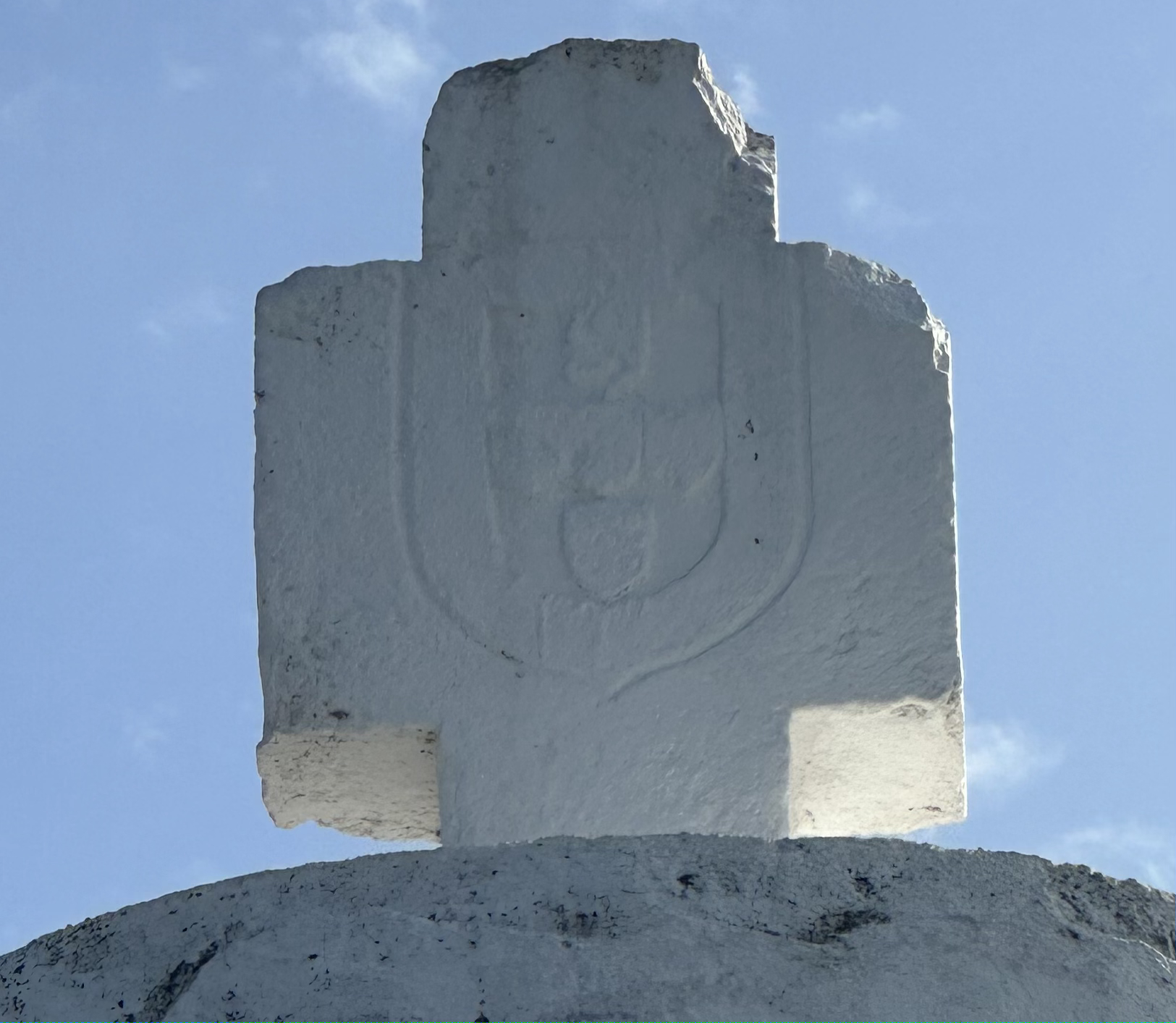
The Vasco da Gama Pillar at Malindi, Kenya, the only padrão erected on the African coast still standing at its original site. The bell-shaped base dates from a nineteenth-century reinforcement; the cross above is the original Lisbon limestone. Source: Wikimedia Commons https://upload.wikimedia.org/wikipedia/commons/1/11/Vasco_da_Gama_Pillar_cross_Malindi.jpg
Who owns them: a room in Lisbon
The question of ownership is answered most concretely in a single room in Lisbon. The Sociedade de Geografia de Lisboa holds four original African padrões in its museum. Three are Diogo Cão’s: the Santo Agostinho pillar from Cabo de Santa Maria in Angola, brought to Lisbon in 1892 after a commemorative marker replaced it on the headland; the fragmentary São Jorge from the mouth of the Congo, shattered by a Dutch raid in 1642; and the Cabo Negro pillar of 1486.6 The fourth is Dias’s: two surviving fragments of the São Tiago from Lüderitz, claimed for Portugal in 1865 and shipped from Cape Town the following year. It is worth correcting a common confusion here. The Dias padrão in Lisbon is the São Tiago, not the São Filipe, which was never recovered at all.
Three afterlives
Taken together, the surviving padrões fall into three kinds of afterlife. There is survival in place, as at Malindi. There is colonial-era removal to a metropolitan museum: Cão’s pillars to Lisbon, the Cape Cross padrão to Berlin, and from Berlin, in 2019, back again to Namibia. And there is the slow archaeological resurrection of a monument that had ceased to exist as an object at all, as at Kwaaihoek, where a few thousand fragments became a cross again. Only the São Filipe, somewhere on the Cape of Good Hope, kept none of these. It simply disappeared.
There is a particular feeling that comes from standing in front of one of these stones. Part 1 of this series ended on the thought of touching something placed on an African headland before Columbus left Spain. The padrões that survive let you do exactly that, but they also ask a quieter question. The pillar at Malindi still faces the ocean it was meant to claim, weathered down to a stub, watched over now by a Kenyan museum rather than a Portuguese crown. The Kwaaihoek cross was reassembled not by an empire but by a university, fragment by fragment, as an act of curiosity rather than conquest. The men who carried these blocks of limestone south believed they were marking the edge of the world for whoever came after them. Five centuries later, we are the ones who came after. We read the inscriptions they left, in a Latin addressed to us and not to the people whose shores they marked, and we decide what the stones mean now. That decision, and not the planting, is the part of the story still being written.
References
- The fullest account of Axelson’s search and the reconstruction is his own: Eric Axelson, Congo to Cape: Early Portuguese Explorers (London: Faber and Faber, 1973), especially the chapters on Bartolomeu Dias’s farthest cross.
- On the toponymy and the individual padrões of the Dias voyage, see Eric Axelson, “The Dias Voyage, 1487–1488: Toponymy and Padrões,” Revista da Universidade de Coimbra 34 (1988): 29–55.
- On the reconstruction, the 1941 replica, and the heritage status of the cross, see A.J.R. Russell-Wood, The Portuguese Empire, 1415–1808: A World on the Move (Baltimore: Johns Hopkins University Press, 1998), 58–60.
- On the São Tiago padrão, its dispersal, and the 1953 excavation, see Paweł Kardasz, “A History of the Padrão de São Tiago at Lüderitz,” The South African Archaeological Bulletin 78, no. 218 (2023): 11–21.
- On da Gama’s reception at Malindi and the erection of the pillar, see Malyn Newitt, A History of Portuguese Overseas Expansion, 1400–1668 (London: Routledge, 2005), 60–66.
- On the recovered padrões now in Lisbon, see António Maria de Castilho, Os Padrões dos Descobrimentos Portuguezes em Africa (Lisbon: Typographia da Academia, 1871); and the object catalogue of the Museu da Sociedade de Geografia de Lisboa.


