


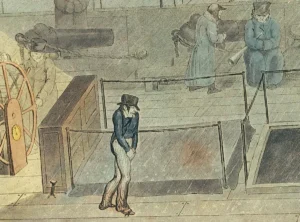
“Midshipman Blockhead, Master B on the Middle Watch, cold blows the wind & the rain’s coming on” by George Cruikshank, June 1820/July 1821. (Royal Museums Greenwich, pu4723; low-resolution image in the public domain.)
Despite the preponderance of headline diseases such as scurvy, the Age of Sail witnessed a multitude of much more common afflictions. This month’s post in our series of Health at Sea in the Age of Sail focuses on one such problem, pleurisy, which was predominantly caused by the often highly variable weather conditions at sea.
Some illnesses at sea announced themselves with spectacle—the spotted rash of typhus, the swollen gums of scurvy, the violent purging of dysentery. Others began much simpler: a breath drawn too deeply, followed by sudden pain.
Before dawn, a sailor might come below from his watch clutching his side. Only hours earlier he had stood on deck in driving spray, his clothes soaked through by wind and rain. Now each inhalation sent a sharp stab beneath the ribs. He could breathe only in short, guarded gasps. Fever followed quickly. His pulse ran hard and fast. To the ship’s surgeon, the pattern was familiar. This was pleurisy, an inflammation of the membrane lining the chest and surrounding the lungs.1
Few disorders better reveal the intimate relationship between environment and disease in the Age of Sail. Ships exposed men to cold wind, wet clothing, foul air, sudden climatic change, physical exhaustion, and crowded sleeping quarters. Under such conditions, chest complaints were common. Some proved mild. Others killed swiftly.
Pleurisy occupied an uneasy place in early modern medicine. It was recognizable in symptoms, yet uncertain in boundaries. Surgeons could identify the stabbing pain, the fever, and the difficulty breathing, but they could not always distinguish inflammation of the pleura from pneumonia, tuberculosis, or other diseases of the chest. What they knew for certain was that when breathing itself became painful, danger was close.
What was Pleurisy?
The term pleurisy derived from the pleura, the membrane enveloping the lungs and lining of the inner chest wall. In classical and early modern medicine,2 pleurisy referred to inflammation in this part of the body, usually marked by acute pain on one side of the chest, fever, cough, and difficulty drawing breath. The pain often worsened when the patient inhaled deeply, coughed, or changed position.
To eighteenth-century physicians, pleurisy was generally classified among the inflammatory diseases. Blood was thought to become overheated, thickened, or driven into the vessels of the chest, producing pain and fever. Exposure to cold after exertion was a common explanation, as was the sudden suppression of perspiration. A sailor who sweated heavily while hauling ropes, then stood chilled in wet clothes on an exposed deck, seemed a textbook candidate.3
Yet pleurisy was not always a distinct condition. Medical writers often discussed it alongside peripneumony—inflammation of the lungs—or treated the two as overlapping complaints. Without stethoscopes, X-rays, or laboratory tests, diagnosis depended on the patient’s account, the surgeon’s eye, and the progress of symptoms over time.
Still, pleurisy had one advantage as a diagnosis: it hurt in a very particular way. Even when the underlying cause remained obscure, the knife-like pain in the side was difficult to mistake.
Cold Winds, Wet Hammocks: Why Sailors were Vulnerable
Life at sea generated ideal conditions for chest disease. Sailors worked in an environment of constant exposure. Watches were stood in darkness, rain, and freezing spray. Men climbed the rigging high above the deck in winter winds or labored shirtless under tropical suns, only to be drenched moments later by sudden squalls. Clothing, once wet, often remained wet for days.
Below decks, conditions were little better. Hammocks hung close together in crowded spaces where ventilation was poor and air thick with tar, sweat, damp canvas, and smoke from the galley. Men recovering from fever slept mixed with the healthy. Coughs echoed through the berth deck at night. In such quarters, respiratory illness spread easily.4
Fatigue further weakened resistance. Sailors frequently worked interrupted sleep schedules, long watches, and bursts of exhausting labor during storms or battle. Nutrition was uneven, and many men reached their positions at sea already vulnerable from poverty or prior illness. In these circumstances, the chest became one more site where maritime strain registered itself.5
Naval physicians repeatedly linked disease to climate. Cold and moisture were especially feared as causes of inflammatory complaints. Warm climates brought their own dangers, but a wet North Atlantic crossing or winter blockade could be just as punishing. The Age of Sail was global, but the body carried every latitude within it.
Diagnosis, Bleeding, and the Surgeon’s Dilemma
Diagnosis at sea depended on observation rather than instruments. The ship’s surgeon listened to his patient’s complaints, watched the movement of the chest, felt the pulse, and judged the heat of his skin. Where exactly was the pain? Did it worsen on inhaling? Was there cough? Could the patient lie flat? Had fever appeared suddenly or gradually? Such questions guided treatment, but certainty was elusive.
A sharp pain in the side might indeed suggest pleurisy, yet other disorders could present similarly. Pneumonia, then commonly termed peripneumony, often brought fever, cough, and difficulty breathing. Tuberculosis might begin with chest discomfort before progressing to wasting and chronic cough. Rheumatic pain in the muscles between the ribs could mimic inflammation within the chest. Even digestive complaints sometimes produced pain that patients described as “in the side.” Without the means to see inside the body, diagnosis remained provisional.6
Because delay was considered dangerous, surgeons often treated first and refined their judgment later. Pleurisy belonged to the family of inflammatory diseases, and inflammation demanded prompt reduction. The standard remedy was bloodletting.7 If the patient was young and robust, the lancet might be applied immediately, often to remove a substantial quantity of blood. Physicians believed that this reduced vascular tension, relieved congestion in the chest, and prevented more serious complications.8
If pain persisted, bleeding could be repeated. Blistering agents were then commonly applied to the side or chest, raising painful vesicles on the skin in hopes of drawing inflammation out from deeper tissues. Warm poultices or fomentations might also be used. Mild purgatives cleared the bowels; they were thought to lessen internal fullness and restore balance. Diet was restricted to broths, barley water, or other light fare. Rest, although often difficult to secure aboard ship, was considered essential.
The surgeon’s dilemma lay in knowing whether treatment had come soon enough. Some patients improved after bleeding, their breathing easing as fever subsided. Others worsened despite every measure, the pain deepening into cough, delirium, or collapse. In those moments, the limits of maritime medicine became painfully clear.
Pleurisy Today
Pleurisy has not vanished.9 The term is still used in modern medicine to describe inflammation of the pleura, usually causing sharp chest pain that worsens with breathing, coughing, or movement. What has changed are the causes we can identify and the tools available to treat them.
Modern pleurisy commonly arises as a complication of pneumonia, viral infection, pulmonary embolism, autoimmune disease, or tuberculosis. Physicians can now distinguish these conditions through imaging, blood tests, and careful examination. Antibiotics, anti-inflammatory drugs, anticoagulants, and supportive care have transformed outcomes that once carried grave uncertainty.
Yet the bodily experience remains strikingly familiar. A patient with pleuritic pain today still describes the same guarded breathing, the same instinct to remain motionless, the same fear produced when each breath hurts. In that sense, the testimony of eighteenth-century sailors is immediately recognizable across the centuries.
Maritime environments also continue to matter. Fishing crews, offshore workers, naval personnel, and those serving in polar or storm-prone waters still face cold exposure, fatigue, and respiratory infection. Modern ships are safer, drier, and better ventilated than their wooden predecessors, but the sea remains a demanding workplace where illness can escalate quickly and distance complicates care.
Pleurisy therefore offers more than a story of obsolete medicine. It reminds us that breathing is a vulnerable act shaped by environment, labor, and disease. For sailors in the Age of Sail, every breath could become a calculation between necessity and pain.
The Chest at Sea
Pleurisy lacked the dramatic contagion of typhus or smallpox, yet it was no minor complaint. It struck at the most fundamental rhythm of life: one’s breathing. In the crowded and weather-beaten world of the sailing ship, where cold spray, damp hammocks, exhaustion, and shifting climates were ordinary facts of life, inflammation of the chest was both common and feared.
The disease also reveals how early modern medicine understood the body. Surgeons saw health as a balance of flows and pressures, illness as obstruction, congestion, or excess. Their remedies—often bleeding, blistering, purging, rest—sought to restore order to an internal system they could not directly observe. Sometimes they succeeded; often they did not.
Seen more broadly, pleurisy underscores a central truth of maritime history: the sea did not just transport people and goods across the globe. It entered the body. It chilled the lungs, exhausted the limbs, disrupted sleep, and shaped disease in intimate ways. Whereas scurvy exposed the nutritional limits of empire, and typhus the dangers of crowding, pleurisy revealed the cost of simply drawing breath in a harsh environment.
In the Age of Sail, the ocean was both highway and hazard. It carried ships into the world, while leaving its mark within those who served upon it: sometimes in the form of fever, sometimes in broken bones, and sometimes in the sharp stitch in the side that made every breath a trial.
References
- Trotter, T. Medicina Nautica: An Essay on the Diseases of Seamen, comprehending the history of health in His Majesty’s fleet, under the command of Richard Earl Howe, admiral, 3 vols. (London: T. Cadell and W. Davies, 1797), 1: 167–173; https://archive.org/details/b21516698_0001/mode/2up.
- Cullen, W. First Lines of the Practice of Physic, 4 vols. (Worcester, MA: Isaiah Thomas, 1790), 1: 265–272; https://archive.org/details/firstlinesofprac13cull/mode/2up.
- Boerhaave, H. Aphorisms: Concerning the Knowledge and Cure of Diseases, trans. J. Delacoste (London: B. Cowse and W. Innys, 1715), 214–216; https://archive.org/details/b30539201/page/n5/mode/2up.
- Brown, K. Poxed and Scurvied: The Story of Sickness and Health at Sea (Barnsley: Seaforth Publishing, 2011), 88–96.
- Macdonald, J. Feeding Nelson’s Navy: The True Story of Food at Sea in the Georgian Era (London: Chatham, 2006), 154–161; https://archive.org/details/feedingnelsonsna00jane.
- Porter, R. Disease, Medicine and Society in England, 1550–1860, 2nd ed. (London: Macmillan Press, 1993), 102–108.
- Lind, J. An Essay on Diseases Incidental to Europeans in Hot Climates with the Method of preventing their fatal Consequences (London: T. Becket and P. A. de Hondt, 1768), 45–48; https://wellcomecollection.org/works/fnvvxq2c/items.
- Trotter, Medicina Nautica, 1: 167–173; Cullen, First Lines, 1: 265–272.
- Trotter, Medicina Nautica, 1: 167–173; Cullen, First Lines, 1: 265–272.


I appreciate medical history articles such as this one on pleurisy at sea during the age of sail and how they were treated.