


My origins according to 23 and Me
I’m not a scientist and DNA is pretty scientific, so there is no way I’m an expert in this area, and any errors in this piece are mine. But as a family historian and lay-person I have done a couple of tests, explored the different platforms that offer tests or the option to upload test results, and done professional development in this area. So, I hope I’ve got some ideas of why you might want to do a test – or not, the ethics of this area, and what you can expect from your results – or not. DNA testing for family history is really popular, and an idea of what it involves is useful to be aware of.
The ethics of DNA testing is crucial. There are a number of questions to ask yourself – and the paperwork before you do a test is generally pretty thorough. It’s important to decide whether you are comfortable with a private company having and retaining a sample of your DNA. Popular company 23andMe went bankrupt last year ago which caused uncertainty for a lot of their customers, including myself. The company has since been bought, but this demonstrates how fragile some of these businesses can be.
Health is another area to consider. Some companies offer health-based results, usually for an extra fee, which show your likelihood of inheriting certain health conditions. Do you want to know? Do you want your insurers want to know? Slightly bizarrely the company Living DNA, who I uploaded my results to for free, helpfully offered me the chance to buy a selection of vitamins and supplements that, according to my DNA, I need. I didn’t take them up on that.
DNA results can also bring surprises and reveal family secrets. Do you want to risk upsetting the apple cart or finding out something potentially explosive? Conversely, tests can help to solve such mysteries, although, as I will explain later, it’s a case of putting DNA results and paper records together.
So, you’ve decided to go ahead. For choosing a company I would recommend looking at a family history magazine or consult the International Society of Genetic Genealogy’s wiki, which has heaps of good information about all things DNA. These companies offer up to three types of test, each based on a different type of DNA. The most popular and widely offered is the autosomal test – you inherit 50% of this type of DNA from each of your parents, 25% from each of your grandparents etc, going back about 6 or 7 generations to where you inherit about 1% to 3% from each ancestor, and potentially none from some as it the inheritance can be uneven.
If you want to go back further you could do either a mitochondrial test, which follows the line of your mother’s mother’s mother’s mother’s etc DNA back to ancient times, or if you are a man or have a Y chromosome you can do a Y-DNA test, which focuses on your father’s father’s father’s line. These tests give you a haplogroup though which you can trace those pieces of DNA back many generations and follow their journey. For example, my mDNA haplogroup is U4a1b, and my Y-DNA (thanks to my uncle testing) is R-M269. From these I can get an idea of the journey some of my DNA has taken over thousands of years. Ancient DNA can help solve historical mysteries. It was mitochondrial DNA from Richard III’s sister’s line that confirmed it was his skeleton in that Leicester carpark.
My origins, according to Ancestry
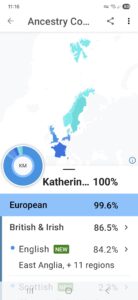
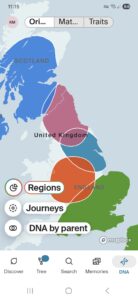
Broadly speaking, the results of your standard autosomal DNA test show you areas of the world where your ancestors lived over the last 200 years or so, and give you basic details of people who match your DNA in some way, using the centimorgan unit of measurement, from close relatives to distant cousins. This is where those surprise results can turn up – such as unexpected half siblings. One really important thing to consider is that each testing platform has a different database of DNA – different people have tested with different companies so you will get slightly varying results – and matches – on different platforms. For example, according to My Heritage I have a tiny bit of Spanish and Portuguese, but not on Ancestry. Platforms also tend to update results at times as more refined information comes to hand.
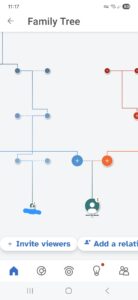
My tree on 23 and Me – how I’m related to a cousin, but need to do more work to add the names.
To me, DNA results are like a hand – you can see that you have a third cousin, they’ve added a bit of their family tree so you think they could be related on your mum’s side but you don’t know how. Historical records are like the glove that you can add to the hand – you can poke about and realise they are your third cousin on your dad’s maternal grandmother’s side. Some platforms really only go in for the DNA aspect with the tree being minimal, but other platforms, like Ancestry and My Heritage do both, so it can be relatively straightforward to add the glove to the hand. There are also various techniques out there to group your DNA matches together to see how they fit into your tree. Hopefully these results can help you break down a few brick walls.
I have done two DNA tests but have been able to upload the results to various other sites to compare and contrast the results and services. Some platforms don’t let you upload other results onto them (looking at you Ancestry), but generally it is pretty straightforward to download the results file and upload to another site.
So, there you have it, a general overview of the world of DNA testing for family history. It’s continually evolving and developing, and I know I need to keep learning to keep up with it all. Hopefully this gives you an idea about what to consider with a test, and what you might


