


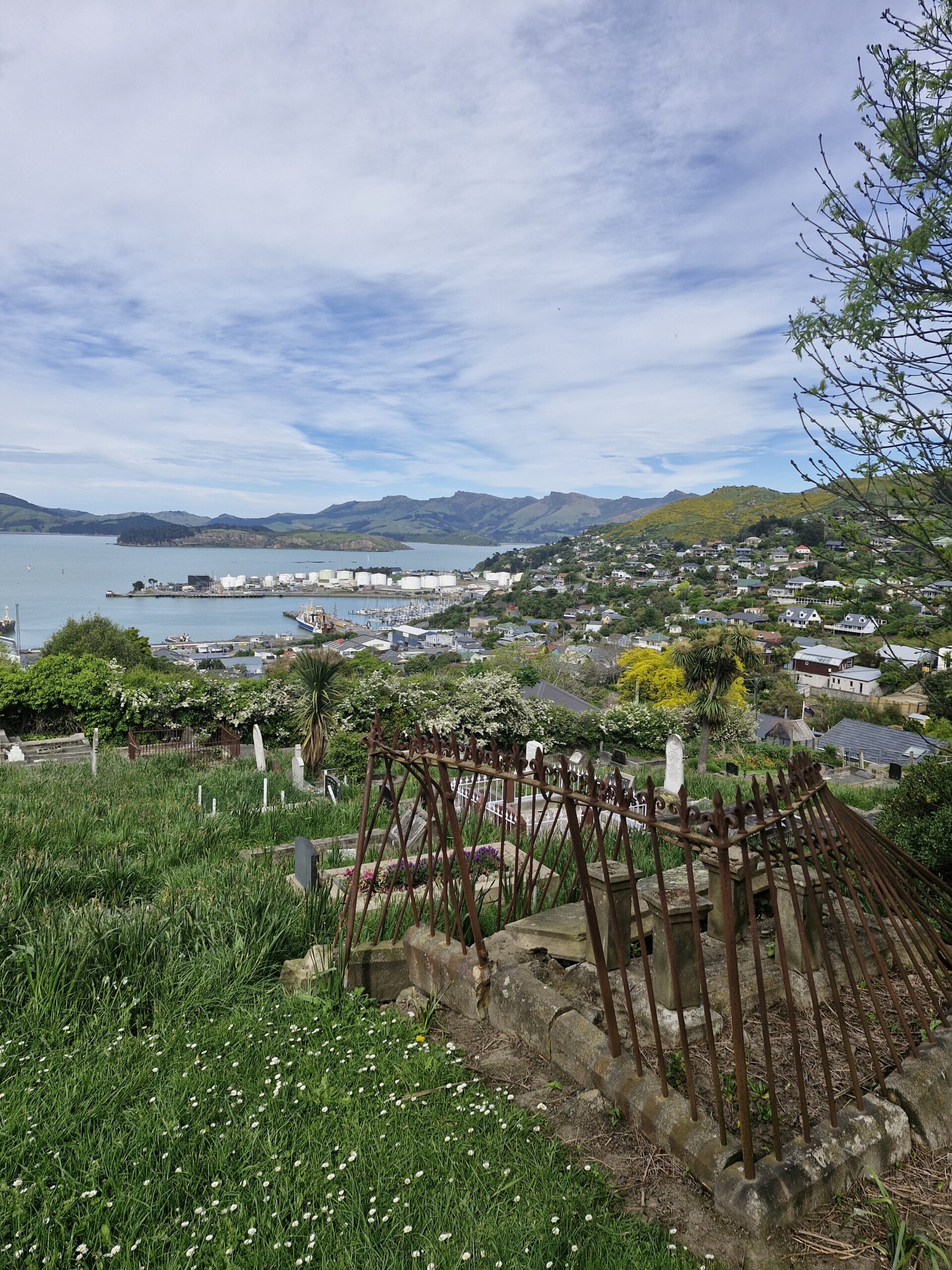
At the end of last year, I paid a visit with some friends to Lyttelton Anglican Cemetery to look for some specific people and also to find some new (to us) stories. Lyttelton is the port for Christchurch, on the east coast of the South Island and is full of maritime and other tales. The cemetery is situated on a hill above the town, overlooking the harbour and Banks Peninsula. Here are a couple of interesting stories I found.
Following various Russian Scares in the 1870s and 1880s, defences around the coast of New Zealand were ramped up. Forts were built and torpedo boats were imported, with the Defender assigned to Lyttelton. As with many scares none of these were ever used in anger, and the Defender was decommissioned in 1899. For the time it was in service the Lyttelton Torpedo Corps had charge of the boat.
On Tuesday 28th November 1893 – the same day as the country’s historic general election – a steam launch was taking some of the corps from Ripapa Island (where there was a fort) across the harbour. The sea was heavy and the boat lurched, the master of the ship John McKenzie and the engineer Fitzroy George Hamilton collided into each other, and both fell overboard. Brave attempts were made by their comrades to rescue them – indeed two of them received awards for their bravery – but both torpedomen were drowned. Hamilton’s body was recovered the following day, and McKenzie’s a fortnight later. Flags in the town, including those on polling stations, were lowered to half-mast.
An inquest for Fitzroy Hamilton was held at the Mitre Hotel, Lyttelton, a couple of days later where a verdict of accidental death was reached. Suggestions for more safety features for the launch they fell from were also suggested. No inquest was held for John McKenzie, although when I was investigating if he did or not, I did find a probate for another mariner called John McKenzie, just be confusing, but he was from Auckland. A military funeral was held for McKenzie on 14th December, where there was a large attendance, with the Lyttelton Volunteer Corps, the police, the Permanent Artillery and other local organisations represented.
Both McKenzie and Hamilton were married with young children, and a week later a fundraising concert was held at the drill shed in Lyttelton to raise funds for them. Entry was either 1 or 2 shillings and an excellent programme was promised. Today, McKenzie and Hamilton are buried together in Lyttelton Anglican Cemetery (thought I’d taken a photo of the headstone, but I hadn’t)
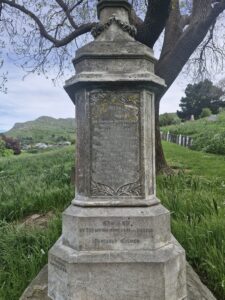
Memorial to the Culmer family in Lyttelton Anglican Cemetery, October 2026, my own photo
Also buried together in the same cemetery are the Culmer family, five of the 18 victims who were lost when the barque Clyde was wrecked at the Snufflenose, in Horseshoe Bay, near the entrance to Akaroa Harbour in November 1884. Captain Edward Culmer was master of the ship which was bringing a shipment of sugar from Dunedin to Lyttelton, having originally come from Mauritius. Also on board were his wife Margaret and their three children, Mary Margaret, 6 and a half, Edward Thomas, 4 and Edith May, 2, and a number of crew.
Culmer was an experienced captain, having sailed the east coast of the South Island / Te Waipoumanu for a number of years. However on this particular early morning the sea was heavy and the Clyde ran aground. A lifeboat was launched, with hopes of saving Margaret and the children, but this was soon swamped. Indeed, there was only one survivor of the disaster, a boy named George Gibson. He walked several miles across the peninsula to Duvauchelle to send telegrams altering the authorities – telegrams which were reported in local newspapers – but it was too late. When ships arrived on the scene, all that was visible was the top of a mast.
It is unclear if more than three bodies were recovered – Captain Culmer, ship’s boy Herbert Bohle, and an unidentified body with red whiskers – but the Culmer family are memorialised in Lyttelton, where the captain’s mother lived. Bohle was buried in Akaroa. Inquests and customs enquiries were held, with young George Gibson repeating his harrowing story a number of times. However, there is often not much that can be done against heavy seas.
All over the world the sea still regularly takes lives, and these are just two examples of such stories which are local to Christchurch, New Zealand.
As well as PapersPast I also used New Zealand Shipwrecks by C W N Ingram as a source.


