


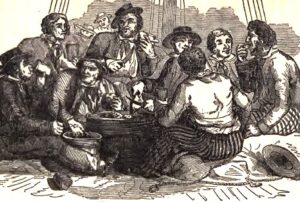
The Sailors’ Mess, by Robert W. Billings, from George Little, The American Cruiser’s Own Book (1849), p. 45. The image postdates the main period discussed here but vividly evokes communal eating aboard ship.
This month’s instalment in our Health at Sea in the Age of Sail series turns from dramatic epidemics and life-threatening injuries to a more ordinary, but no less revealing, complaint. Dyspepsia rarely stopped a voyage or filled a surgeon’s journal with crisis, yet it exposed the everyday pressures of shipboard life: preserved food, hurried meals, alcohol, fatigue, anxiety, and the relentless timetable of the ship. Through the uneasy stomach, we can glimpse how deeply the routines of maritime labour entered the body.
A sailor’s dinner in the Age of Sail was designed to keep him working, not necessarily to keep him comfortable. Salt beef or pork, dried peas, oatmeal, and ship’s biscuit supplied the energy required to haul ropes, climb rigging, man guns, and endure long watches. The food was durable, measurable, and comparatively resistant to months at sea. It could also be tough, monotonous, heavily salted, hastily eaten, and difficult to digest.
Soon after a meal, a sailor might feel an uncomfortable pressure beneath his ribs. His stomach swelled with wind. Sour fluid rose into his throat, accompanied by belching, nausea, or pain. His appetite might disappear, only to return unpredictably. The symptoms were rarely spectacular enough to halt a voyage, yet they could persist for weeks, reducing strength, disturbing sleep, and making every duty more burdensome.
Naval surgeons could call such complaints dyspepsia. Today, the word generally means indigestion, but eighteenth- and nineteenth-century dyspepsia was a much broader and less stable diagnosis. It encompassed fullness, epigastric pain, nausea, vomiting, flatulence, disturbed appetite, and irregular bowels. It could also include fatigue, headache, anxiety, melancholy, and nervous irritability. Dyspepsia was not merely a disorder of the stomach. To many contemporary practitioners, it revealed that the proper conversion of food into health, strength, and even emotional stability had begun to fail.1
Dyspepsia reflected not simply what sailors ate but how quickly they ate, when they ate, and how fatigue, anxiety, alcohol, and disrupted sleep affected the body. The stomach became a barometer of maritime life.
More than indigestion
Dyspepsia was difficult to define, because it described a collection of symptoms rather than a single identifiable disease. Nineteenth-century physicians associated it with fullness after eating, pain in the upper abdomen, nausea, vomiting, and altered bowel habits. Historians have consequently described dyspepsia as a diagnosis in which “people, disease, and emotions” became unusually entangled.2
The meaning of the diagnosis also changed over time. By the Victorian period, dyspepsia was increasingly portrayed as a “disease of civilization,” especially among people believed to be overwhelmed by intellectual work, emotional strain, urban habits, or dietary excess. Yet the medical ideas behind this diagnosis had deeper roots. William Cullen (1710–1790), the Scottish physician and professor at the Edinburgh Medical School, had classified dyspepsia among the neuroses in the eighteenth century; later practitioners explored the relationship between the stomach, the nerves, and the mind.3
John Abernethy (1764–1831), the influential London surgeon, offered one of the fullest early nineteenth-century accounts of this constitutional approach. He believed that disorders of the digestive organs could arise from weakness and irritability rather than from visible structural damage. Their persistence without fatal consequences suggested, he argued, “that it is a disorder of functions, and not a disease of structure.”4
That distinction made dyspepsia both useful and elusive. A sufferer could experience disabling symptoms without presenting a lesion that could be seen, felt, or confirmed after death. Diagnosis therefore rested on patterns of appetite, digestion, pain, vomiting, bowel movements, sleep, mood, and physical strength.
Abernethy described diminished appetite and digestion, flatulence, altered excretions, tenderness in the upper abdomen, and a furred tongue. He also looked beyond the stomach. The dyspeptic patient might become irritable and despondent, with “anxiety and languor” visible in the face. Slight exercise could bring perspiration and exhaustion, while even sound sleep might leave the sufferer unrefreshed and incapable of movement.5
The stomach, in other words, spoke for the entire constitution.
Eating against the clock
Life aboard ship offered myriad opportunities for digestion to be disturbed. Meals were governed by bells, watches, weather, discipline, and duty. A sailor did not necessarily eat when hungry or rest after eating. He ate when food was served and returned to work when required. A sudden change of course, worsening weather, or a call to quarters could interrupt the meal or send him directly from the mess to strenuous labor.
A revealing parallel comes from the Devonport dockyard in 1869. The staff surgeon recorded 94 cases of dyspepsia, principally among young women employed in the ropery. He attributed their “derangement of the digestive system” partly to the mere half hour allowed for their midday meal. The women then returned immediately to the machinery. Their principal meal might consist of meat pudding, suet pudding, and pork: substantial food consumed quickly, with little opportunity for digestion before labor resumed. The report concerns dockyard workers rather than seamen, but its logic is strikingly maritime: even adequate food could disturb health when eaten rapidly and followed by an immediate return to physical labor.
Abernethy expressed a similar principle. Patients should not, he warned, “oppress the powers of the stomach by too great a quantity of food,” nor take another meal until sufficient time had passed for the first to be digested.6 Such advice assumed a degree of personal control that ordinary sailors rarely possessed. Their stomachs had to accommodate their ship’s timetable.
Salt provisions and uneasy digestion
The naval ration was an achievement of logistics. Preserved meat, biscuit, dried legumes, grain, beer, and spirits enabled ships to remain at sea for extended periods. Yet provisions chosen for durability were not necessarily those recommended for a disordered stomach.
Abernethy favored food that was “nutritious, and easy of digestion”: plain broths, tender meat, milk, eggs, and starchy vegetables. His simplest rule was that patients should avoid anything they were unlikely to digest.7 For many sailors, this was impractical advice. Fresh milk and eggs soon disappeared on a long voyage. Meat was preserved in salt, biscuit hardened with age, and vegetables became scarce unless the ship reached a port where fresh provisions could be obtained.
This does not mean that naval food inevitably caused dyspepsia. Sailors accustomed to the standard ration often tolerated it, while officers with access to richer dishes, wine, private stores, and more elaborate meals could suffer from excess. Dyspepsia could belong to scarcity, monotony, overindulgence, or irregularity. What mattered to contemporary physicians was the relationship between the food and the “powers of the stomach.”
Abernethy insisted that quantity should be proportionate to digestive capacity. Food beyond what the stomach could process provided no additional nourishment. Worse, he believed it burdened the circulation and exhausted the body. Moderation therefore became both a dietary and a moral prescription. The healthy eater exercised restraint; the dyspeptic body revealed that the proper limits of appetite, digestion, and constitution had been exceeded.
At sea, however, moderation meant different things. A sailor might bolt down a large meal because it was his only substantial food for hours, while an officer dining at greater leisure might suffer from richer food. The stomach registered rank, routine, opportunity, and necessity.
Rum, wine, and the digestive stimulant
Alcohol occupied an ambiguous place in this medical world. Beer, wine, and spirits were embedded in naval provisioning and social life. Alcohol could warm, stimulate, encourage appetite, and make monotonous food more tolerable. It could also irritate the stomach, worsen nausea, and contribute to habitual digestive disturbance.
Abernethy did not condemn alcohol outright. A moderate quantity after dinner, he suggested, might prevent discomfort and promote digestion. Strong fermented liquors taken at other times were another matter: “It is wrong to stimulate the stomach when it has no task to perform.”8
This distinction is revealing. Alcohol was neither inherently therapeutic nor harmful: its effect depended upon timing, amount, constitution, and purpose. A small quantity accompanying food might support the stomach; repeated stimulation could weaken it. The same substance could be ration, remedy, comfort, and cause.
Shipboard medicine operated within precisely such ambiguities. The surgeon could not separate the sailor’s symptoms neatly from his food, drink, labor, sleep, or emotional state. Dyspepsia emerged from their interaction.
The surgeon’s diagnostic puzzle
Because dyspepsia did not have a single defining sign, diagnosis required close questioning. When did pain begin? Did it follow eating immediately or arise several hours later? Was vomiting painful or effortless? What had been brought up? Was nausea accompanied by headache, sweating, or dizziness? Did the bowels move regularly? Had the patient lost weight or appetite?
Later nineteenth-century physicians regarded the timing and character of vomiting as important clues. Vomiting immediately after food might suggest gastric irritation, while delayed vomiting during digestion could be interpreted as dyspeptic. Pain, nausea, and the nature of the expelled material helped distinguish local stomach disease from disorders believed to originate in the brain, nerves, or other organs.9
A ship’s surgeon faced additional uncertainty. Nausea could arise from seasickness, spoiled food, fever, alcohol, medication, anxiety, or infection. Abdominal pain might indicate dysentery, obstruction, hepatitis, or an ulcer rather than dyspepsia. Without laboratory tests or medical imaging, the diagnosis remained provisional.
The tongue assumed particular importance. Abernethy treated its appearance as a guide to the stomach: whiteness, dryness, or fur suggested irritation or defective secretion. Appetite, stools, urine, pulse, sleep, and expression completed the picture. The surgeon assembled meaning from the body’s surfaces because he could not observe digestion directly.
Regulating the maritime body
Treatment aimed less at eliminating a specific disease than at restoring orderly function. The patient might receive bland food, smaller portions, bitters, mild stimulants, or medicines intended to regulate the bowels. Rhubarb, gentian, senna, and other preparations appeared in Abernethy’s therapeutic discussion. He valued regular evacuation but warned that powerful purges could increase irritation and worsen the disorder.10
Rest and routine mattered as much as medicine: meals should be moderate, digestible, and properly spaced; alcohol restrained; and the bowels regulated without violent intervention. Again, the ideal treatment conflicted with maritime reality. A sailor could not always rest after eating, select tender foods, regulate his schedule, or avoid anxiety. The ship itself dictated much of his treatment, and much of his illness.
Dyspepsia rarely killed with the speed of epidemic disease. It left no dramatic rash, no unmistakable wound, and no heroic surgical operation. Yet its very ordinariness makes it historically important. It shows how maritime health was shaped by repeated, everyday negotiations between appetite and ration, meal and watch, stimulation and exhaustion.
Abernethy believed disturbed digestion could produce weakness, impair the blood, irritate the brain, and “thus influence the whole body.” That conviction may appear extravagant today, but its underlying insight remains recognizable. Digestion is not isolated from work, mood, sleep, or environment.
The sailing ship carried food across oceans, but it also imposed the conditions under which that food had to be eaten and endured. In the Age of Sail, the uneasy stomach was more than an inconvenience. It was the body’s running commentary on life aboard ship.
References
- H. Brieger, “Dyspepsia: The American Disease? Needs and Opportunities for Research,” in Healing and History: Essays for George Rosen, ed. Charles E. Rosenberg (New York: Science History Publications, 1979), 179–190.
- Brieger, “Dyspepsia,” 179–190.
- Denis Gibbs, “The Demon of Dyspepsia,” in Gastroenterology in Britain: Historical Essays, ed. W. F. Bynum (London: Wellcome Institute for the History of Medicine, 1997), 29–42.
- John Abernethy, Surgical Observations on the Constitutional Origin and Treatment of Local Diseases; and on Aneurisms (London: Longman, Hurst, Rees, and Orme, 1809), 60.
- Abernethy, Surgical Observations, 16–18.
- Abernethy, Surgical Observations, 64–65.
- Abernethy, Surgical Observations, 64.
- Abernethy, Surgical Observations, 66–67.
- Rachael Russell, “Nausea and Vomiting: A History of Signs, Symptoms and Sickness in Nineteenth-Century Britain” (PhD Thesis, University of Manchester, 2012), 65–66.
- Abernethy, Surgical Observations, 68–73.


I appreciate this article and the reference of Abernathy (as an independent historian, writer, former sailor and registered nurse.)