


Shannon McSheffrey is Distinguished Research Professor of History at Concordia University in Montreal. Her publications over the last three decades have concerned the social, legal, and cultural history of England between the Black Death and the mid-sixteenth century, most recently focused on socio-cultural histories of crime and migration. Her 2017 Oxford University Press book, Seeking Sanctuary: Crime, Mercy, and Politics in English Courts, 1400-1550, considered the legal processes and broader socio-political ramifications of English churches’ offering asylum. She has also developed several major online projects, such as Consistory: Testimony in the Late Medieval London Consistory Court and Sanctuary Seekers, and contributes to blogs and podcasts, including a recent appearance discussing sanctuary on the Gone Medieval podcast.

A ship sailing over a fish-filled sea, from Brunetto Latini, Li livres dou tresor; British Library, Add MS 30024, fol 64v. Public Domain; digitized by the British Library.
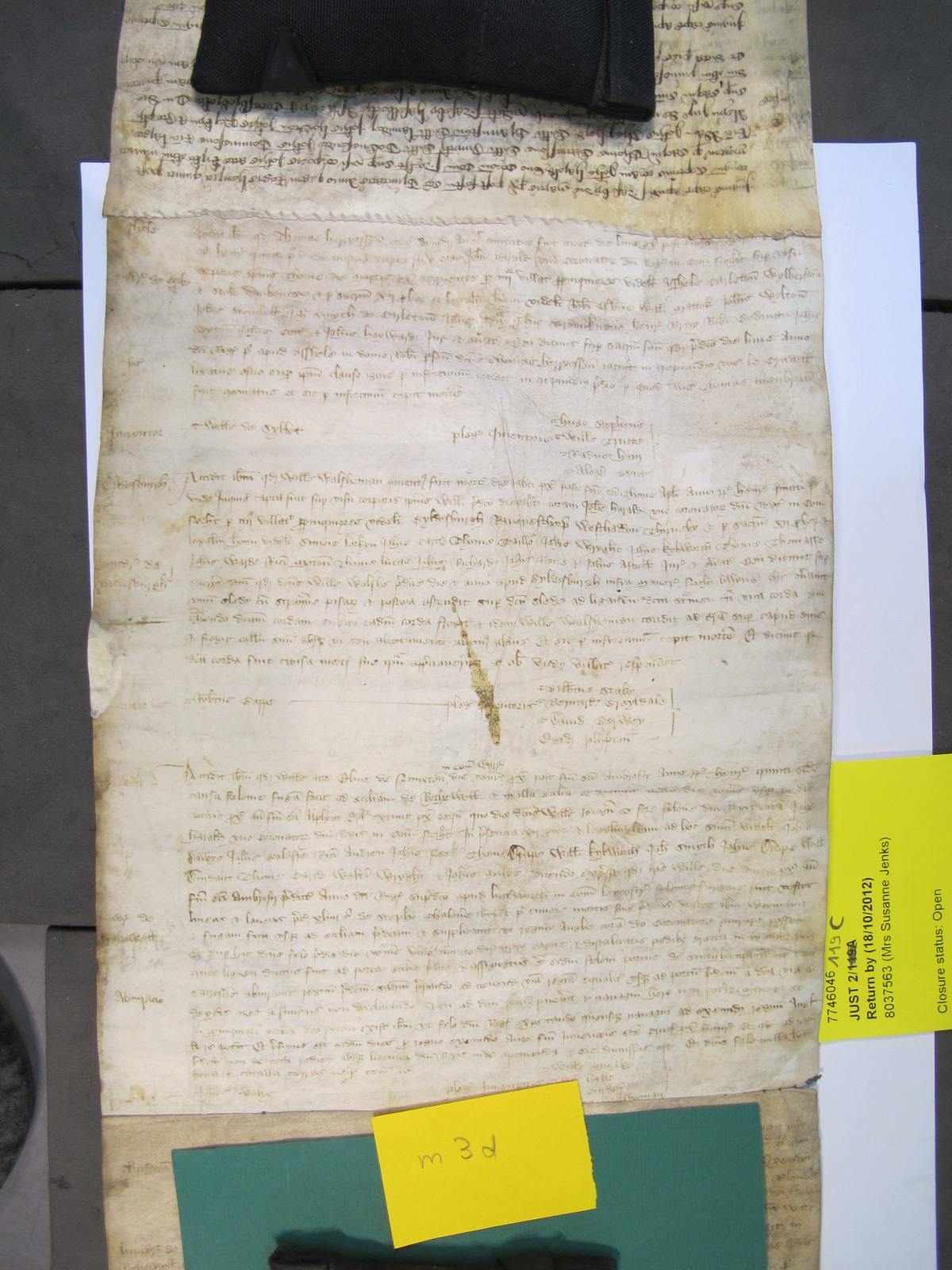
Towards the end of October 1452 Thomas Kendale, an English labourer, fled to the parish church in Norton, Hertfordshire. There he confessed to having stabbed one Thomas Whitemore in the heart with a dagger, killing him. We might naturally assume that as he was in a church Kendale made his confession to a priest, looking for religious absolution. In fact, however, he made his admission of the crime to a royal official. This was a formal step in a procedure of the English criminal law between the thirteenth and sixteenth centuries, available to accused felons. In a form of sanctuary, a criminal could flee to any parish church or churchyard to escape arrest. This was a venerable practice in Christianity from its early centuries, but its later medieval English version had several quirks. Though nothing in Christian theology or canon law set a time limit on such asylum, in England sanctuary in parish churches was limited to forty days. Within those roughly six weeks, the sanctuary seeker either had to leave the church, risking arrest and execution, or to “abjure the realm,” to go into exile. The latter process was part of the king’s justice, not the church’s mercy. 1
A coroner’s roll at the Anglo-American Legal Tradition; the last entry is a record of abjuration. JUST 2/119C, rot. 3d. Image link: http://aalt.law.uh.edu/AALT7/JUST2/JUST2no119C/IMG_0016.JPG
The first step in a sanctuary seeker’s abjuration of the realm was to ask for the coroner, who acted for the crown (hence the name) in various legal procedures. When the local coroner appeared, the felon confessed the crime before him. The coroner recorded the details on his coroner’s roll, creating an official legal record that the sanctuary seeker had admitted the felony. Such an admission of guilt was normally a death sentence: hanging was the punishment for felony. If the sanctuary-seeking felon did things right, however, they would never have to face the court, for from long-standing common law practice, he (or much more rarely she) could “abjure the realm”. When the felon had confessed and taken the oath to leave the king’s dominion a standard procedure ensued: the coroners gave the felon a white cross to carry so that all would know them as an abjurer, assigned them a port from which to find a ship to cross the Channel, and sent them on their way. In English legal practice the land border with the kingdom of Scotland was only very rarely held to count as going into exile: it had to be “in partibus transmarinibus,” to parts across the sea. In theory – though not always in practice – the abjurer was accompanied by a relay team of constables to ensure they did not deviate from the road to the port. If caught off the road, they were subject to summary execution, as their guilt had already been legally acknowledged before the coroner.
Yet it was not always easy to find a ship to take overseas, as Kendale was to find. Once Kendale had confessed the murder to the Hertfordshire coroner in the parish church at Norton, the coroner assigned him the port of Portsmouth. That was a long walk from Norton, about 100 miles or 160 km, but it made some sense: Portsmouth is as close to Norton as any of the ports on the south coast of England (the shortest passage to “parts across the sea”). By the time Kendale got to Portsmouth, however, it was November and the weather had turned ugly. He waited there for several days, but no one was crossing “owing to the great violence of the sea.” We don’t have the details, but evidently after he failed to find a ship Kendale was taken into custody as an abjurer who had not quitted the realm as he had sworn to do. He was in danger of swift execution even though (he claimed) he had made every effort to go into exile.

Pieter Bruegel the Elder, detail from Netherlandish Proverbs, 1550s, Public Domain via Wikimedia Commons.
Something (again, not recorded) interrupted Kendale’s direct trip to the gallows. We can infer that he was somehow able to make a plea directly to the king, asking his monarch to use the royal powers of mercy to deal with his problem. By this point, however, Kendale’s story had shifted: it was no longer about his blamelessness for his inability to find a ship, but instead a claim that he had not, in fact, committed the murder at all. He said that he had fled to the church and made a false confession only to save his life, as the accusation of murder had been untrue, maliciously made. He feared nonetheless that his enemies would procure his conviction and execution. This avowal of innocence sounds suspiciously convenient at this stage, but it is true that allegations of corruption in the mid fifteenth-century English criminal justice system were all too believable. Henry VI evidently believed Kendale’s story and in March 1453, the king granted Kendale his mercy and the accused murderer walked free.
Kendale was, ultimately, a very lucky man, whether fairly or unfairly accused. But let’s go back to his time in Portsmouth harbour. He must have been very anxious for the few days he sought a passage across the channel. He was not the only abjurer for whom it was difficult to find a ship. Here’s one similar story, for example, and let me briefly tell you another, with some telling details. In 1530, one Henry Danby, a baker from London, confessed to having killed a Franciscan friar and committed a burglary. He abjured the realm and, like Kendale eighty years before, was assigned to go to Portsmouth. In Danby’s case the season was more favourable – it was May – and he did find a ship to take him. When it was out at sea, however, a storm arose and blew the ship back to Portsmouth. The crew threw Danby off the ship and refused to have him back on board, telling him “that since he was an abjured man they would all fare the worse if they took him back in their company on the aforesaid ship.” After this, Danby wandered around the kingdom as a fugitive for a couple of years, with a few picaresque adventures. About two years later he was caught and executed. 2

A floor tile from Chertsey, 13th century. © The Trustees of the British Museum. Shared under a Creative Commons Attribution-NonCommercial-ShareAlike 4.0 International (CC BY-NC-SA 4.0) licence.
There is no indication in the post-Black Death period that captains were recompensed for taking abjurers; they were to do it from their innate Christian charity, but they might well have asked why they and their crew should have to bear such a burden. In general in the fifteenth and early sixteenth centuries, the whole process of abjuration was weak on structural support. That might not always have been true: the historian William C. Jordan has argued that in the decades around 1300, there were many more abjurers than in the fifteenth century and that the crown had a system. 3 Abjurers, Jordan argues, were sent to Dover virtually exclusively rather than the plethora of different ports used in the fifteenth and sixteenth centuries. If the exile-in-waiting arrived in the winter months when passages across the channel were few, they were housed in the prison in Dover Castle to await the spring and the new shipping season. The crown recompensed ship captains for taking the abjurers over the channel into France. But for various reasons the systemic aspects of that process fell apart in the aftermath of the Black Death and there is no sign of anything nearly as systematic from the mid fourteenth century to the sixteenth. As far as we know (because records are patchy), by around 1400, relatively few people took sanctuary in parish churches and abjured the realm, though in the 1480s the practice was to rebound somewhat. By then another form of sanctuary which did not send its seekers into exile but instead allowed them to stay in certain monasteries and religious houses had become more common. 4 The 1450s were right in the middle of various transitions in the English practice of sanctuary; most relevantly, in the 1450s sending an abjurer into exile was a practice that was not unknown but infrequent enough that there wasn’t any infrastructure to deal with it. If you arrived at a port like Portsmouth in November 1452 and the sea was “violent” and no one was sailing, you might be stuck there for some time, without money to pay for lodging or food and no one likely to hire you to make a wage. Maybe someone would help you out of charity, but there was no counting on that.
There’s a lot of important scholarship on abjuration: see especially Jordan’s From England to France, referenced above; Karl Shoemaker’s Sanctuary and Crime in the Middle Ages, 400-1500; Jessica Freeman, “And He Abjured the Realm of England, Never to Return,” in Freedom of Movement in the Middle Ages: Proceedings of the 2003 Harlaxton Symposium, ed. Peregrine Horden (Shaun Tyas, 2007); Krista Kesselring’s “Abjuration and its Demise”.
References
- For more on sanctuary and its various forms in the late medieval period, see my “Sanctuary Seekers” website, https://sanctuaryseekers.ca/explainer/; for Kendale’s case, see the Calendar of the Patent Rolls here: https:/https://aalt.law.uh.edu/AALT7/JUST2/JUST2no119C/IMG_0016.JPG/babel.hathitrust.org/cgi/pt?id=uc1.31158013042337&view=1up&seq=78&q1=Kendale.
- For Danby’s case see J. H. Baker, ed., The Reports of Sir John Spelman, 2 vols., Selden Society 93 and 94 (Selden Society, 1977), 2:278-80.
- For his argument, see Jordan’s book From England to France.
- See “Sanctuary Seekers”, https://sanctuaryseekers.ca/explainer/.