


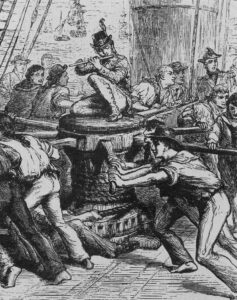
Seamen working a capstan, nineteenth century, artist unknown. (Public domain, Wikimedia Commons.)
This month’s instalment in our Health at Sea in the Age of Sail series turns to a complaint that was rarely dramatic but deeply characteristic of maritime life: lumbago. Lower-back pain sat at the intersection of hard physical labor, cold, damp, fatigue, and the limits of what a sailor’s body could endure. In an environment where hauling, lifting, climbing, and bracing were unavoidable, a painful back was more than an inconvenience—it threatened a man’s ability to work at all.
A sailor’s back was one of the most heavily used parts of his body. He hauled on ropes, heaved at capstans, climbed rigging, carried stores, shifted guns, launched boats, rowed, scrubbed decks, and slept in a hammock that moved with the ship beneath him. Much of this work was performed in cold wind, driving rain, or clothes that could remain damp for hours. A sudden movement on a rolling deck, one awkward lift, or one violent pull on a line could leave him unable to straighten himself without pain.
Such a man might report to the ship’s surgeon complaining of pain “in the loins.” If fever and obvious injury were absent, the diagnosis might be lumbago.
Today the word sounds antiquated, but in eighteenth- and early nineteenth-century medicine it had a reasonably clear place. Lumbago was usually understood as a form of rheumatism affecting the lower back. William Cullen (1710–1790), whose First Lines of the Practice of Physic became one of the most influential medical texts of the period, placed it within chronic rheumatism. When rheumatic pain affected “the vertebrae of the loins,” he wrote, the condition was called lumbago. He also observed that chronic rheumatism particularly attacked joints surrounded by muscles employed in “constant and vigorous exertions.”1
That description could hardly have been better suited to sailors.
Rheumatism of the Loins
Lumbago was not a disease in the modern pathological sense. It was a label applied to a pattern of pain: stiffness and aching in the lower back, commonly worsened by movement and often attributed to rheumatism. The term derived from the Latin lumbus,2 the loin or lower back, and for physicians of the period its meaning was primarily anatomical.
Cullen distinguished chronic rheumatism from its acute form. Acute rheumatism was associated with fever, inflammation, swelling, and pains that could move across body parts. Chronic rheumatism, by contrast, might leave a joint or region cold, stiff, and painful without obvious fever. Heat could relieve it; cold could worsen it. Lumbago was one manifestation, while pain centered on the hip became sciatica.3
Cullen’s account also made strenuous labor relevant. He noted that violent strains or spasms following sudden exertion could produce rheumatic complaints that soon became chronic.4 In modern terms, some of the men diagnosed with lumbago were almost certainly suffering from muscular strain, ligament injury, or other mechanical causes of lower-back pain. Others may have had arthritis, spinal disease, kidney problems, or referred pain from elsewhere.
At sea, the diagnosis therefore began with a simple practical question: could the man move?
A Working Disease
The physical demands of a sailing warship made the lower back particularly vulnerable. The ship itself required continuous muscular labor. Raising anchor meant working the capstan. Setting or reducing sail meant hauling lines under tension. Stores, ammunition, water, provisions, and equipment had to be lifted and moved by hand. Gunnery imposed its own burden: naval guns weighing well over a ton each had to be run out, fired, sponged, loaded, and hauled back into position by gun crews working in confined spaces.
The deck beneath all of this labor was never reliably still.
That matters. A load that could be lifted predictably on shore might shift as the vessel rolled. A sailor climbing or hauling had to adjust his balance constantly. Sudden force could arrive through a rope, a spar, or another man losing his footing. Even routine work involved twisting, bracing, pulling, and lifting in awkward postures.
Cullen’s observation that rheumatism favored muscles subjected to repeated vigorous exertion therefore maps remarkably well onto maritime labor.
The problem was not restricted to acute injury. Mid-eighteenth-century naval records show rheumatism among the conditions serious enough to contribute to discharge from service. A study of Royal Navy personnel records for the 1770s lists men invalided with rheumatism, sometimes alongside scurvy, consumption (tuberculosis), or other chronic complaints.5
By 1808, a monthly return from the British Baltic squadron recorded forty-five cases of rheumatism among more than 11,000 seamen.6 Lumbago was only one part of that broader diagnostic category, but back pain clearly belonged to a much larger burden of rheumatic disease at sea.
Cold, Damp, and the Maritime Body
Contemporary medicine placed enormous importance on cold and damp. Rheumatism was repeatedly associated with exposure, especially when a heated or perspiring body was suddenly chilled.
Again, the sailing ship offered ideal conditions. A sailor might leave the warmth of the lower deck for the midnight watch and emerge into cold wind or rain. Clothes soaked by spray could not always be dried quickly. Bedding and hammocks absorbed moisture. Wooden decks were routinely washed and drying them in bad weather was difficult.
Later naval observers remained convinced that these conditions encouraged rheumatism. Accounts of nineteenth-century shipboard health repeatedly linked damp quarters and abrupt transitions from warmth to cold with rheumatic and catarrhal complaints. One medical observer noted that men leaving their beds for night watches could move almost instantly from a hot sleeping space into a cold atmosphere, sometimes while still perspiring.7
Herman Melville (1819–1891) gave the same problem a sailor’s voice in White-Jacket (1850). Describing the repeated washing of a frigate’s decks, he complained that in sunless weather sailors’ quarters remained so damp that a man could scarcely sit down without risking “the lumbago.” One rheumatic old sailor, he added, had sewn tarred canvas onto the seat of his trousers.8
Melville wrote after the period at the center of his series, but the complaint captures beautifully what naval medical writers had long feared: the devastating combination of wetness, cold, and bodily fatigue.
The Surgeon’s Problem
Back pain was easy to report and difficult to verify.
A sailor complaining of lumbago might move stiffly, struggle to bend, or wince when the lower back was pressed. Yet the surgeon could not see a lesion. There might be no wound, swelling, fever, or discoloration. Diagnosis depended heavily upon what the patient said he felt.
That created another peculiarly naval difficulty: malingering.
William Turnbull (fl. 1779–1806), himself a former Royal Navy surgeon, devoted space in his Naval Surgeon (1806) not only to rheumatism, lumbago, and sciatica but also to “feigned rheumatism.”9 The reason is understandable. Pain without visible pathology could excuse a sailor from some of the hardest work aboard ship. Yet genuine lower-back pain could be profoundly disabling while leaving almost nothing for a surgeon to observe.
This ambiguity could place sick sailors under suspicion. Historians of naval medicine have shown that surgeons worried about illnesses whose diagnosis relied heavily on a patient’s testimony, and men accused of feigning rheumatism could face punitive treatment or be transferred rather than simply believed.10
Lumbago therefore occupied an uncomfortable position between illness and discipline. A sailor might be genuinely unable to haul a rope or lift a weight, yet his disability had to be demonstrated in a culture where physical usefulness was central to his value aboard ship.
Warmth, Rubbing, and Rest
Treatment depended partly on whether rheumatism was considered acute or chronic. The distinction was important because bleeding and purging, commonly used against inflammatory illness, were less attractive once fever and obvious inflammation had disappeared.
For chronic rheumatic complaints, warmth and external stimulation became central. Shipboard medical manuals recommended preparations such as opodeldoc (a traditional soap-and-alcohol liniment infused with camphor and herbal oils), spirits of turpentine, volatile liniment, and spirits of camphor, rubbed onto the affected body parts.11
Other treatments could include cupping, leeches, blistering, opiates, camphorated preparations, and stimulating liniments. A late eighteenth-century maritime medical recipe for rheumatism combined mustard, antimony, camphor, opium, spirits, and rubbing of the affected body part.12
Many of these remedies aimed to restore warmth, stimulate the skin, draw inflammation away from deeper tissues, or relieve pain. The most obvious remedy, however, was also the most difficult aboard ship: rest.
A man with a strained lower back would benefit from avoiding lifting and twisting. A sailor’s occupation demanded precisely those movements. Even if placed on the sick list temporarily, he remained aboard a vessel whose manpower was finite. During battle, storm, sail handling, or emergency, the division between the sick man and the working sailor could quickly become blurred.
The maritime environment could therefore both cause the complaint and obstruct its cure.
The Back as a Measure of Labor
Lower-back pain reveals the cumulative physical cost of sailing ships. Maritime history often celebrates endurance: men climbing aloft in storms, gun crews working under fire, sailors heaving together at capstan and line. Lumbago shows the other side of that labor. Bodies became sore, stiff, strained, and sometimes temporarily useless.
Contemporary medicine interpreted much of this through the language of rheumatism. Cold entered the body, damp aggravated pain, exertion strained the muscular frame, and warmth promised relief. Modern medicine would divide those cases among muscular strain, degenerative disease, nerve compression, inflammatory disorders, and a range of other diagnoses. The historical category was broader, but the experience beneath it remains immediately recognizable.
A sailor who could not straighten his back could not simply stop being a sailor.
That may be the central point. Lumbago was not merely pain in the loins. It was pain in the part of the body upon which much of shipboard labor depended. The sailing ship demanded strength from the back every day, and when that strength failed, the limits of the maritime body became impossible to ignore.
References
- Cullen, W. First Lines of the Practice of Physic, 4 vols. (Edinburgh: C. Elliot, 1788), 1:179, §§452–453.
- Aronson, J. “Round the Back,” British Medical Journal 329 (2004): 1289.
- Cullen, First Lines, 1:179, §§451–452.
- Cullen, First Lines, 1:179, §453.
- McLeod, A.B. The Mid-Eighteenth Century Navy from the Perspective of Captain Thomas Burnett and His Peers (PhD diss., University of Exeter, 2010), table 10 (p. 192), University of Exeter Research Repository.
- Davey, J. “The First Year in the Baltic, 1808.” In The Transformation of British Naval Strategy: Seapower and Supply in Northern Europe, 1808–1812. (Cambridge: Cambridge University Press, 2012), 99–124 (chap. 5).
- Rands, F. “Comments on the Health of the Navy 1825–1840.” RNZN Communicators Association. November 25, 2014
- Melville, H. White-Jacket; or, The World in a Man-of-War (New York: Harper & Brothers, 1850), chap. 18.
- Turnbull, W. The Naval Surgeon: Comprising the Entire Duties of Professional Men at Sea (London: Richard Phillips, 1806), 130–134.
- Caputo, S. “Treating, Preventing, Feigning, Concealing: Sickness, Agency and the Medical Culture of the British Naval Seaman at the End of the Long Eighteenth Century.” Social History of Medicine, 35 (2022): 749–769; doi: 10.1093/shm/hkab108.
- Ritter T., A Medical Manual and Medicine Chest Companion: For Popular Use in Families and on Ship-Board, for the Treatment of the Ordinary Diseases of the Human System (New York: S. W. Benedict, 1849).
- Almon, W.J. “A Popular Remedy for the Rheumatism.” In Manuscript Notebook of Dr. William James Almon, late eighteenth century, p. 156, Almon Family Fonds, MG 1, Microfilm Reel 10,045, Nova Scotia Archives; transcription and metadata in “A Popular Remedy for the Rheumatism.” Early Modern Maritime Recipes, University of New Brunswick.


