



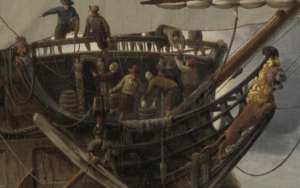
“Dutch ships in a calm sea” (detail); Willem van de Velde the Younger (1633–1707), ca. 1665. Note the sailor in the ship’s beakhead relieving himself and the swab-looking item hanging from the upper headrail, which sailors used to clean themselves after use of the heads. (Rijksmuseum Amsterdam; public domain.)
Last month, we talked about shipboard lavatories as part of our regular “Health at Sea in the Age of Sail” features. This month, we continue that theme by considering a very common affliction that caused much embarrassment.
A common embarrassment
While the maritime history of disease has long been dominated by dramatic and outwardly visible afflictions—scurvy, dysentery, yellow fever—other conditions, less conspicuous but no less troubling, shaped the daily medical realities of life at sea. Among these was obstipation: the severe or persistent obstruction of the bowels, commonly termed ‘costiveness’ by early modern medical practitioners. Although rarely fatal, obstipation was nevertheless regarded as dangerous and uncomfortable—and potentially deadly if neglected. In the confined, regimented, and nutritionally impoverished environment of sailing ships, obstipation was a frequent complaint and a persistent source of anxiety for both patients and surgeons.
Far from being a trivial inconvenience, the condition was believed capable of provoking fever, colic (sudden bouts of pain), delirium, and even death. Early modern medicine regarded regular evacuation of the bowels as essential to health, and the failure of this fundamental bodily function signalled dangerous internal disorder. At sea, where diet, water supply, mobility, privacy, and medication all conspired against normal digestion, obstipation emerged as a distinctively maritime problem.
Early modern medical writers employed a flexible vocabulary to describe disordered bowel function. Costiveness, obstruction of the bowels, torpor (inactivity) of the intestines, and suppression of stool all appeared in surgical manuals and domestic medical guides.1 Obstipation referred not merely to infrequent defecation but to a stubborn resistance to purgation, often accompanied by abdominal pain or distension (swelling caused by pressure from the inside).
Within humoral medicine, regular evacuation was essential to maintain balance. Retained excrement was thought to putrefy within the body, corrupting the humors and generating internal heat.2 The bowels were not passive conduits but active organs whose failure could poison the entire system. William Buchan (1729–1805) warned that costiveness “… lays the foundation of innumerable diseases …,” while naval surgeons feared that obstruction could rapidly progress to inflammation of the bowels or ileus, that is, disruption of normal intestinal function.3
Importantly, obstipation was not considered a local digestive inconvenience but a constitutional disturbance. Surgeons described it as both cause and consequence of fever, debility, and nervous disorder. This systemic framing made the condition a matter of urgent medical attention, particularly in environments where corrective measures were limited.
Diet, water, and the shipboard gut
The maritime diet of the Age of Sail was inherently constipating. Sailors subsisted largely on salted meat, hard biscuit, dried peas, and rice—foods low in fiber and difficult to digest. Fresh vegetables and fruit were often scarce or absent on long voyages, depriving the body of what surgeons recognised as natural ‘opening’ foods.4
Water scarcity compounded the problem. Drinking water was rationed, often foul-tasting, and frequently avoided by sailors who preferred beer or spirits. Chronic dehydration hardened stools and slowed intestinal transit, which was well understood by contemporary practitioners. James Lind (1716–1794) observed that costiveness was particularly common during long passages, when both diet and hydration were most restricted.5
Digestive irregularity was therefore not just an incidental inconvenience but an expected consequence of maritime provisioning. Surgeons anticipated bowel complaints on long voyages and stocked purgatives accordingly, regarding obstipation as an almost inevitable feature of shipboard life.
Beyond diet, the physical and social conditions of life at sea interfered with normal bowel habits. Sailors lived in cramped quarters, slept in hammocks, and worked long watches that limited opportunities for privacy or regular defecation. Access to the ship’s head was constrained by weather, discipline, and the rhythms of naval routine.6
Motion further disrupted digestion. Surgeons noted that the constant pitching and rolling of a ship could either loosen or bind the bowels, depending on the individual. Prolonged inactivity during calm weather or illness was thought to encourage intestinal torpor, while fear and anxiety were also believed to inhibit natural evacuations.
Regulation of bodies aboard ship was inseparable from discipline. Sailors were expected to conform to schedules that often conflicted with bodily needs, and complaints of constipation carried a degree of embarrassment. Obstipation thus occupied an uncomfortable space between medical necessity and social reservedness.
The shipboard gut in crisis
Obstipation frequently appeared as a complication of other illnesses. Fevers, inflammatory disorders, and wounds were all thought capable of suppressing bowel function, either through internal heat or the effects of medication. Post-operative obstipation was particularly feared. After amputations or major surgical interventions, failure of the bowels to move was seen as a dangerous sign, sometimes interpreted as a precursor to fatal inflammation.7
Naval hospital correspondence and surgeons’ returns repeatedly note costiveness and bowel obstruction following fever, injury, and surgical intervention, particularly among men recovering from amputations or prolonged illness. Reports to the British Sick and Hurt Board describe cases in which obstinate constipation provoked severe colic, vomiting, and dangerous abdominal distension, sometimes with fatal outcomes when purgation failed.8 Such presentations alarmed surgeons, who feared mechanical obstruction or gangrene of the intestines. Without surgical intervention or effective analgesia (pain relief), outcomes could be grim.
Medications commonly used at sea exacerbated the problem. Opium, administered widely to relieve pain and dysentery, was well known to ‘bind the bowels’. Mercury9 and antimonial preparations likewise interfered with digestion. Surgeons thus faced a therapeutic dilemma: the drugs needed to treat one condition might provoke another.
A ‘typical’ case of obstipation may have proceeded along the following lines. A seaman in his early thirties, admitted to a hospital ship after prolonged service in warm climates, was recorded as suffering from obstinate costiveness following a sudden onset of fever. Despite his fever’s subsidence, his bowels would not move for several days, and he complained of increasing abdominal pain, fullness, and nausea. Initial treatment with mild purgatives produced little effect. Stronger cathartics were hence administered, followed by repeated clysters (enemas), which eventually yielded scant, hardened stools.10
The patient’s condition could have fluctuated over several days. Periods of partial relief alternated with renewed distension and colic, raising concern among the attending surgeons that inflammation of the bowels might occur. Dietary measures were attempted, including broths and, when available, fresh vegetables, and the patient was encouraged to walk on deck, weather permitting. Recovery was slow, and convalescence extended well beyond that of his original fever. The case would have been reported to the Sick and Hurt Board as one in which bowel obstruction significantly delayed the sailor’s return to duty, illustrating both the operational and medical consequences of obstipation at sea.
Treatment at sea
As implied in this brief vignette, treatment of obstipation at sea relied on purgation, mechanical stimulation, and dietary correction. Surgeons carried an extensive inventory of laxatives, including senna, jalap, rhubarb, castor oil, and calomel. These were administered alone or in combination, with doses adjusted according to the patient’s constitution and response.11 When oral purgatives failed, clysters were widely employed. Shipboard medical chests routinely included syringes for this purpose, and surgeons described enemas as indispensable in obstinate cases. Warm water, soap, oil, or herbal infusions were injected to stimulate evacuation, sometimes repeatedly.12
Dietary remedies were attempted when possible. Broths, stewed fruits, and fresh vegetables—when available—were prescribed to ‘open the body’. Exercise was recommended, although often impractical aboard ship. Bleeding was occasionally employed when obstipation was associated with fever or perceived internal congestion. Despite these measures, success was not guaranteed. Surgeons recorded frustration when purgatives failed to act, and some cases ended in prolonged suffering or death.
Obstipation was rarely a single episode. Many sailors experienced recurrent bouts, particularly on long voyages. Relapse reinforced the belief that some individuals possessed inherently sluggish bowels, a constitutional weakness that required constant management.13 Admiralty medical returns treated persistent costiveness not merely as discomfort but as a condition capable of prolonging convalescence and delaying a sailor’s return to duty, thus contributing to non-combat attrition within fleets and hospital ships.14 Naval hospital records suggest that while obstipation seldom appeared as a primary cause of death, it contributed significantly to morbidity and prolonged convalescence. Men incapacitated by abdominal pain or repeated purging were unfit for duty, placing strain on crews already stretched thin.
Surgeons’ writings reveal a distinctive anxiety surrounding bowel obstruction. Unlike diarrheal diseases, which discharged their danger visibly, obstipation concealed its threat within the body. This invisibility made it particularly unsettling, a silent accumulation of internal corruption that demanded vigilant attention.
Obstipation in the Age of Sail was thus more than a minor digestive complaint. It was a condition shaped by maritime diet, water scarcity, confinement, discipline, and medical practice—a disease of environment as much as of physiology. For early modern surgeons, the constipated body represented a dangerous failure of natural order, one that threatened systemic collapse if left uncorrected. By attending to obstipation, we gain insight into the everyday bodily struggles of life at sea and the practical challenges faced by shipboard medicine. The management of the bowels—so fundamental, so unglamorous—was central to maintaining health, discipline, and operational effectiveness. The rhythms of digestion hence mirrored the constraints of maritime life itself.
- Buchan, W. Domestic Medicine; or, the family physician; being an attempt to render the medical art more generally useful, by shewing people what is in their own power both with respect to the prevention and cure of diseases. Chiefly calculated to recommend a proper attention to regimen and simple medicines. (Edinburgh: Balfour, Auld and Smellie, 1769).
- Wear, A. Knowledge and Practice in English Medicine, 1550–1680 (Cambridge: Cambridge University Press, 2009).
- Buchan, op. cit.
- Lind, J. An Essay on the Most Effectual Means of Preserving the Health of Seamen, in the Royal Navy. Containing directions proper for all those who undertake long voyages at sea … or reside in unhealthy situations. With cautions necessary for the preservation of such persons as attend the sick in fevers. (London: D. Wilson, 1762).
- Ibid.
- McLean, D. Surgeons of the Fleet. The Royal Navy and its Medics from Trafalgar to Jutland. (London: I.B. Tauris, 2010).
- Blane, G. Observations on the Diseases of Seamen. (London: Joseph Cooper, 1784).
- Office of the Commissioners of Sick and Wounded Seamen. Royal Navy Sick and Hurt Board correspondence. Admiralty series ADM 97 (in-letters, 1702–1862) and ADM 98 (out-letters, 1742–1833). (Kew, UK: The National Archives).
- de Grijs, R. “The ships’ surgeons’ toxic toolkit,” Hektoen International, https://hekint.org/2023/06/07/the-ships-surgeons-toxic-toolkit/ (Spring 2023).
- Composite case vignette based on patterns described in Royal Navy Sick and Hurt Board correspondence and medical returns, Admiralty series ADM 97/8, op. cit.
- Loudon, I. Medical Care and the General Practitioner, 1750–1850 (Oxford: Clarendon Press, 1986).
- Porter, R. Disease, Medicine and Society in England, 1550–1860 (Cambridge, New York: Cambridge University Press, 1995).
- Wear, op. cit.
- Office of the Commissioners of Sick and Wounded Seamen, op. cit.


